


Every December, somebody in the family group chat asks the same question: are we doing bowl picks this year?
Then nothing happens until two days before the first game. One person builds a spreadsheet, half the group never opens it, and the cousin who picks by mascot wins anyway.
This list fixes the planning part. Eight bowl pool formats, from dead simple to properly competitive, plus the dates that matter and the parts Splash can run for you. The mascot cousin is still your problem.
What a college bowl pool is
One long slate, one prize
A college bowl pool is a contest built on the postseason. Everyone picks winners from the bowl schedule, correct picks score points, and the best total when the last game ends takes the prize.
It looks like a weekly pick'em. It plays differently.
The regular season hands you a fresh slate every Saturday. Bowl season hands you one long slate stretched across about six weeks, with games on weekday afternoons, Christmas Eve and New Year's Day. Depending on how your deadlines are set, you might make every pick before the first kickoff and live with them for a month.
The matchups are odd by design. Bowls fill their slots through conference tie-ins, selection committees and at-large picks, and teams usually need six wins to be bowl eligible, as Splash's explainer on how teams qualify lays out. So a 6-6 team from one conference can draw a 9-3 team it didn't play all fall.
That's the appeal. Nobody in your group is an expert on all of these games, which means the person who does a little homework can actually pull away.
Eight bowl pool ideas for your group
Pick the format that fits your crowd
Every idea below starts from the same base as a college football pick em: people pick games, points pile up, someone wins. What changes is how much thinking each one asks for.
The first two are the classic bowl game pick em formats. Ideas 3 through 7 add a twist for groups that want more strategy. The last one is for the group that mostly wants an excuse to talk.
Classic bowl pick em
Pick every winner, count the points
Start here if your group has never done this. Everyone picks the winner of every bowl, each correct pick is worth one point, and the most points wins. That's a bowl pick em, and nobody needs the rules explained twice.
The catch is volume. Nobody has real opinions on every game, so the small bowls turn into coin flips, and coin flips decide close pools. That's fine. It keeps the casual players alive into January.
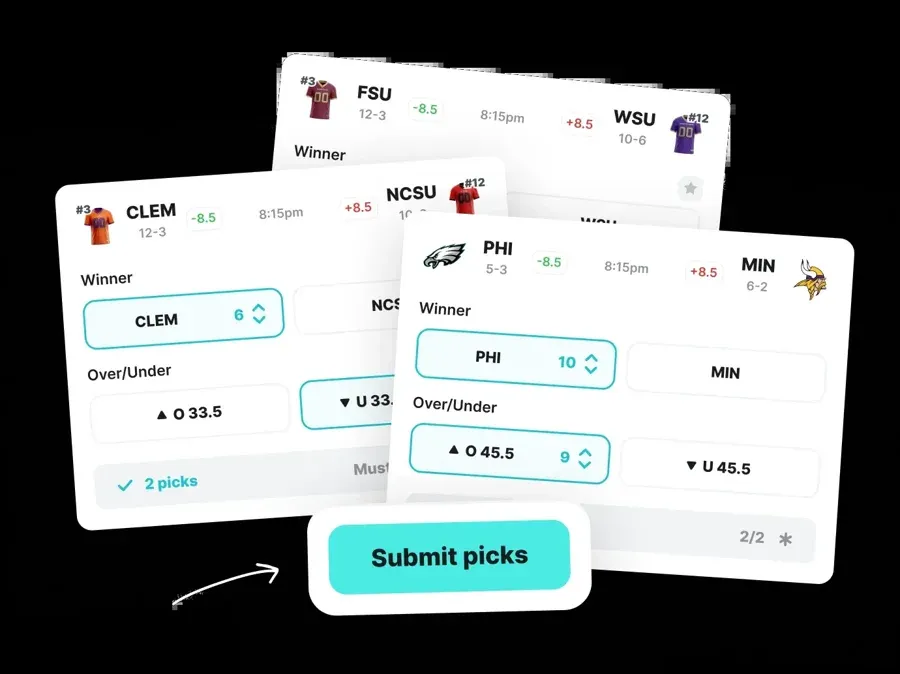
On Splash, Bowl Mode in a college Pick'em contest rolls the bowl games into one postseason slate, so you aren't rebuilding the picksheet by hand. Splash switches it on for the postseason, then you turn it on for your contest. Once it's on, it stays on.
Bowl confidence pool
Rank your hunches, not just your picks
Same picks, one extra step. Everyone ranks every game from most to least confident, and each correct pick scores its rank. In a 30-game pool, your strongest call is worth 30 points and your shakiest is worth 1.
A bowl confidence pool rewards the person who reads up. Being right on a true toss-up barely matters. Knowing which games aren't toss-ups matters a lot.
Splash Pick'em has Confidence scoring built in: entrants rank their picks, and each correct pick earns its rank value. One warning for commissioners. The Standard or Confidence choice is locked in when you create the contest, along with the league mode, so decide it before the first entry comes in.
Playoff-only bracket pool
Eleven games for the playoff-only crowd
Some people only care about the College Football Playoff. Give them a pool built on just the eleven playoff games: four first-round games, four quarterfinals, two semifinals and the title game.
The classic version has everyone fill out the CFP bracket in advance, March Madness style. Great sweat, until one first-round upset wrecks half the sheets before Christmas.
Splash's contest format guide doesn't list a college bracket format, so run the round-by-round version instead. Trim the picksheet to the playoff games and use per-game point values, which run from 1 to 20, so a semifinal counts more than a first-round game. Nobody's pool dies on Dec. 19. Bowl Mode runs through the national championship, but check that the four campus-site first-round games show up on your picksheet before you send invites.
Survivor across bowl season
One winner per window, no repeats
Survivor works in December too. Split bowl season into windows, say the pre-Christmas games, the days after Christmas, New Year's and the playoff run, and have everyone pick one winner per window. Win and you move on. Lose and you're out. Each team can be used once.
That forces a real call. Spend a playoff team early for safety, or save it for a window with nothing better.
Splash Survivor runs college football contests, NFL and college combined, or college narrowed to specific conferences, with settings for extra lives and revivals if the whole field busts. A college contest's schedule can run into the postseason through the national championship. Splash doesn't spell out how the bowl weeks are grouped, though, so check the commissioner settings in the app before you promise your group custom windows.
Conference vs conference pool
Your alumni feud finally gets a scoreboard
Bowl season is when conferences get measured against each other, loudly, in every group chat. Make that the pool.
Everyone makes normal bowl picks, but entrants also join a team by loyalty: SEC people on one side, Big Ten people on another, everyone else with wherever they went to school. Individual standings decide the prize. Team standings decide who gets to talk in January.
Splash Pick'em has Groups for this kind of split. A commissioner can divide entrants into family-vs-family or department-vs-department standings on top of the individual leaderboard, and a conference split works the same way. If you trim the slate to a set number of picks, add a Must Pick on the biggest cross-conference game so nobody can dodge it.
Underdog bonus pool
Make picking the favorite cost something
A straight pick'em has a sameness problem. Most people pick the same favorites, so the sheets look identical and the pool comes down to a handful of games. An underdog bonus pool pays extra for calling the upset, which forces people to take a side.
Splash doesn't list an underdog-only bonus setting, so there are two honest ways to build the same pressure.
Run the contest against the spread, using Splash's spreads or ones you enter by hand, so a favorite only scores if it wins by enough. Or use Best Pick with Standard scoring: entrants tag one or more picks as their Best Pick, and a correct one earns bonus points. Tell the group to spend it on a dog they actually believe in.
Bowl tiers pool
Not every bowl deserves equal points
A weekday afternoon bowl and a playoff semifinal should not count the same. A bowl tiers pool sorts games into levels, playoff games on top, the bigger-name bowls next, everything else at the base, and scores each level differently.
This isn't Splash's Tiers game, which is a player-picking format. It's a scoring idea, and Pick'em handles it with per-game point values from 1 to 20. Put the early bowls at 1 point, the marquee bowls at 3 and the playoff games at 5 or more, and the race stays open deep into January.
Post the point scale before anyone picks. Splash lets you change a game's value right up until it kicks off, but your group will remember exactly who benefited.
Family pool with a low entry fee
Grandma versus the group chat
Some pools aren't really about winning. They're about getting your cousins, your dad and your college roommate onto one leaderboard for a few weeks.
Keep the entry fee small, run Standard scoring straight up and skip the spreads. Fast Picks let anyone fill a slate in one click, all home teams, all favorites or random, and Auto Picks cover the relative who forgets the deadline exists.
Two details matter more in a family pool than anywhere else. Minimum ages vary by state, from 18+ to 21+, and some states where Splash runs contests exclude NCAA ones. Check every player's state on the availability page before anyone sends money.
How to run a bowl pool without spreadsheets
Let the app chase the late payers
The spreadsheet version of a bowl pool comes with three jobs nobody wants: collecting money, grading picks after every game and settling the tie on Jan. 26. Hand all three off.
Here's the setup order on Splash, with the settings you can't change later first:
- Create a college Pick'em contest. Choose the league mode and the Standard or Confidence format. Both are fixed once the contest exists.
- Turn on Bowl Mode. Once Splash opens it for the postseason, it rolls the bowl games into one slate. It's permanent for that contest, so flip it on purpose.
- Pick straight up or against the spread. Spreads come from Splash, frozen at your lock time, or you enter your own game by game.
- Set points and a tiebreaker. Do this after Bowl Mode is on, because switching it on resets game values and Must Picks. Per-game values run from 1 to 20, and a score prediction on one designated game settles ties. The last game on your slate is the default.
- Send the invite. Turn on Contest Vault, built with LeagueSafe, to collect, hold and pay out entry fees in one place, or keep handling money the way your group always has. You decide who gets paid and when.
After that, the work mostly disappears. Picks lock at kickoff, scores post as games end, members get reminders before deadlines, and the commissioner can still edit bowl pool picks after lock for the person whose flight had no Wi-Fi.
For the full commissioner playbook, read how to host a pick'em pool without the usual chores. Then build yours in the Splash Pick'Em game.
Check first
College contests aren't offered in every state where Splash runs other games. Confirm your players' states on the availability page before you set an entry fee.
Bowl season dates to plan around
Circle these before the invites go out
ESPN's 2026-27 schedule, published June 3, listed 36 bowl games plus 11 College Football Playoff games, with the Arizona Bowl's date still to be announced. The lineup has moved since. NCAA.com's schedule, updated Oct. 27, adds a new San Juan Bowl on Dec. 16 and doesn't list every game ESPN does.
So treat the exact count as unofficial until the matchups are announced. Build your contest now and open picks once the teams are in place.
2026-27 bowl season dates (ESPN, June 3, 2026; NCAA.com, Oct. 27, 2026; CFP)
| Date | What happens |
|---|---|
| Sun., Dec. 6 | CFP Selection Day: the 12-team field is revealed |
| Sat., Dec. 12 | Bowl season opens with the Cricket Celebration Bowl in Atlanta |
| Fri., Dec. 18 to Sat., Dec. 19 | CFP first round, four games at campus sites |
| Tue., Dec. 22 | The new Puerto Rico Bowl debuts in Bayamón |
| Thu., Dec. 24 | Christmas Eve doubleheader: New Mexico Bowl and Hawai'i Bowl |
| Wed., Dec. 30 | CFP quarterfinal at the Vrbo Fiesta Bowl |
| Fri., Jan. 1 | CFP quarterfinals at the Cotton Bowl, Peach Bowl and Rose Bowl |
| Sat., Jan. 2 | Last scheduled non-playoff bowls: Citrus, First Responder and Liberty |
| Thu., Jan. 14 to Fri., Jan. 15 | CFP semifinals at the Orange Bowl and Sugar Bowl |
| Mon., Jan. 25 | CFP National Championship at Allegiant Stadium, Las Vegas |
Three dates matter most for your pool. Dec. 6 is when anything playoff-related can be finalized. Dec. 12 is your real entry deadline if the pool covers every game. Jan. 2 is where a bowl-only pool can wrap up, while a playoff pool runs more than three weeks longer.
Some kickoff times, including the Jan. 1 quarterfinals, still read TBD on the official CFP site, so set deadlines game by game instead of one fixed time. Need a starting point for which bowl games deserve the most points? Splash's old list of bowl games ranked from worst to best is a fun template for the argument.
Frequently asked questions
The questions your group asks first
Roughly three dozen bowls plus the 11-game College Football Playoff. ESPN and NCAA.com still list slightly different sets of bowls, so the final count isn't official yet. Six playoff games are hosted by bowls: the Fiesta, Cotton, Peach and Rose for the quarterfinals, and the Orange and Sugar for the semifinals.
You pick a winner in every game, then rank those picks from most to least confident. A correct pick earns its rank value, so in a 30-game pool your most confident pick is worth 30 points and your least confident is worth 1. Wrong picks score nothing, and the most total points wins.
Yes, where college contests are offered. Splash Pick'em runs college football contests, and once Splash opens Bowl Mode for the postseason, it rolls the bowl games into one slate with Standard or Confidence scoring, straight up or against the spread. Some states exclude NCAA contests, so check the availability page before you invite anyone.
Create the contest in November so invites and entries can come in early, then switch on Bowl Mode and open picks once the matchups are set after Selection Day on Dec. 6. The first bowl kicks off Dec. 12, which is your practical deadline if the pool includes every game.
A score prediction on one designated game is the cleanest. Splash Pick'em supports that, plus a reorderable cascade behind it, such as wins, Best Pick hits or fewer auto-picks used, so you decide exactly how a tie breaks before it ever happens.


