


Your group chat has three referral links in it. Each one comes with a different app, a different welcome offer and a friend who swears theirs is the one.
They all look the same from the app store. Bright screens, big prize numbers, a player you recognize on the splash page.
The real differences are quieter. How much of each entry fee goes back out as prizes. How fast your money comes home. If a format is even open where you live. And who you're really playing: other fans or the company running the app.
This guide walks through each one, in the order you should check them.
What daily fantasy sports sites offer
One slate, one entry, one leaderboard
Key takeaways
- Daily fantasy contests run for a single day or week of games, not a whole season.
- Peer-to-peer sites earn from the gap between entry fees collected and prizes paid out.
- Peer-to-peer sites put you against other players. House-style games put you against the operator.
- Availability, minimum age and even the formats on offer can change from state to state.
- On Splash Sports, every opponent is a fellow player, from your group chat or the public lobby.
Daily fantasy sports packs a fantasy season into one slate. You pick players for a single day or week of games, their real stats turn into points, and the contest settles when the games end. Splash's own explainer on how daily fantasy sports works lays out the classic version: draft a fresh roster under a salary cap for each contest, then score off real performance.
Daily fantasy sports sites have since split into a few shapes. Salary cap contests ask you to build a roster under a budget. Pick'em formats ask you to call individual player stats. Tiers formats split the player pool into groups and you take one from each.
Contest sizes vary, too, from head-to-head matchups to big tournaments with thousands of entries.
What doesn't vary much is the business model. DraftKings' 2025 annual report says its DFS revenue is "the difference between the entry fees collected and the amounts paid out to contestants as prizes." Keep that sentence in mind. It's the lens for every section below.
If you want the industry view, the Fantasy Sports & Gaming Association has invested in research on fantasy players for more than 15 years. Its FSGA industry research page lists the reports, and members get the newest ones first.
How to compare DFS sites, step by step
Five checks before you hand over a card number
Most DFS sites get compared on one thing: the size of the welcome offer. That's the least durable number on the page. Offers change. Fees and payout rules stick around.
Run fantasy sports apps through these checks instead, in this order:
- Can you play here? Open the site's availability page and find your state or province. Check the specific format you want, not just the app.
- Who is your opponent? Other players, or the operator? The answer changes how prizes work.
- What does a contest keep? Compare the prize pool with what the entries bring in.
- How does the money come back? Look at when winners get paid and how withdrawals work.
- Do the formats fit how you watch sports? One night of picks, a weekly lineup or a season-long pool with friends.
A site that fails step one doesn't need the other four. A site that passes all five has earned a small first deposit, not a big one.
Tip
Make your first deposit small and run one full cycle: enter a contest, let it settle, then request a withdrawal. You'll learn more about a site in that loop than from any review.
Entry fees & rake
The prize pool tells you what a contest keeps
Rake is the share of entry fees a contest doesn't pay back out as prizes. It's how peer-to-peer DFS operators get paid for running the contest.
You can usually work it out yourself. Multiply the entry fee by the number of entries, then compare that with the posted prize pool.
Here's a made-up example with round numbers, not Splash's rake or any other site's. A contest charges $10, holds 100 entries and pays out $900. Entries bring in $1,000, so the contest keeps $100, or 10%. Same fee, same field, a $950 prize pool? Now it keeps 5%.
That's why the entry fee alone tells you very little. Two $10 contests can return very different amounts to the players.
Guaranteed contests add a wrinkle. The prize pool is promised whether or not the contest fills. If the entry fees collected come in below that promised pool, the operator covers the gap. That gap is called an overlay, and the players in the contest split more than they paid in.
Then there's the welcome offer. Looking for a Splash Sports promo code? Current offers show in the app, and they change, so check there instead of trusting a code from a third-party site. The same goes for any DFS app: read the offer's terms before you count it as value.
Good to know
House-style pick'em games have no shared prize pool to split. You play against the operator, and its posted payouts set what you can win.
Payouts & withdrawals
Winning only counts once the cash moves
Start with the prize table. It tells you how many places pay and how much each one gets. DraftKings' annual report describes its prizes the same way, paid out to the top finishers in each contest as defined by that contest's prize table.
Read it before you enter. A contest that pays a thin slice of the field at the top suits a different mood than one that pays half the room.
Then look at timing. In the Splash Sports app, payouts hit winners' balances automatically once the contest is over, ready to withdraw right away. There's no commissioner holding the pot and no Venmo chase in March.
Deposits and withdrawals on Splash run through Paysafe, a payments partner, inside the same app where you make your picks.
For any DFS site, find the help page that lists withdrawal methods and processing times before you deposit. Check whether times are listed by method, whether the clock starts when you request or when the request is approved, and what identity checks come first.
Splash's help pages also explain why it asks for a photo ID. Get that done early, not the night you win.
Availability & DFS legal states
Your location decides the menu
Search for DFS legal states and you'll find confident maps on plenty of sites. Treat them as background reading. They can't tell you what a specific app offers where you're standing tonight.
The operator's own availability page can. Splash lists where you can play by state and province, format by format: Survivor, Pick'Em, Tiers and One & Done, QuickPicks and Predictions. Some states show a format as available without NCAA contests. Minimum age varies too, at 18+, 19+ or 21+ depending on where you are.
Big picture, Splash covers most of the US and all of Canada except Quebec.
The same habit works on any app. Don't stop at whether the app works in your state. Check whether the format you want does.
Every site that runs paid contests will also check where you are. On Splash, the law requires a location check before any deposit or contest entry. Its location verification guide covers the usual snags: turn off ad blockers, disconnect from a VPN and avoid secured Wi-Fi networks, which can cause problems.
So a list of daily fantasy sports legal states is a starting point at most. The availability page and the location check are the answer.
Tip
Traveling? Your location is checked where you are, not where you live. A format you play at home may not be on the menu in the next state over.
Peer-to-peer vs house-style DFS apps
Know who's on the other side of your entry
This is the question most people skip. It matters more than the logo.
On peer-to-peer DFS apps, your opponents are other players. Entry fees build a prize pool, the best entries split it, and the operator runs the contest. DraftKings, for one, describes its DFS products, Pick6 included, as peer-to-peer play where contestants compete against each other for prize money.
House-style daily fantasy apps work differently. You play against the operator. That model has been shrinking. PrizePicks ran "against the house" pick'em for years, then announced on August 22, 2025 that it was moving every state and territory where it operates to Arena, its peer-to-peer format. When Arena launched in January 2024, RotoGrinders summed up the difference: it pits users against each other instead of against the house.
Why it matters to you: in a peer-to-peer contest, the people you beat are in the same contest. In a house game, the company paying your prize is also your opponent.
Splash is peer-to-peer from end to end. Your competition is your friends and other fans, never the company. That holds whether you join a public contest or create a private one and send the link to your group, with Splash collecting entries and paying the winners.
For a longer breakdown of the two models, read our take on peer-to-peer vs sportsbooks.
Choosing between pick em apps & salary cap sites
Pick the format that matches your week
Salary cap sites are the classic version. Each athlete carries a price tag, your roster has a budget, and the craft is squeezing value under that ceiling. It rewards people who like spreadsheets and late-night lineup tinkering.
Pick em apps strip that down. You choose individual players and call their stats, with no roster to balance.
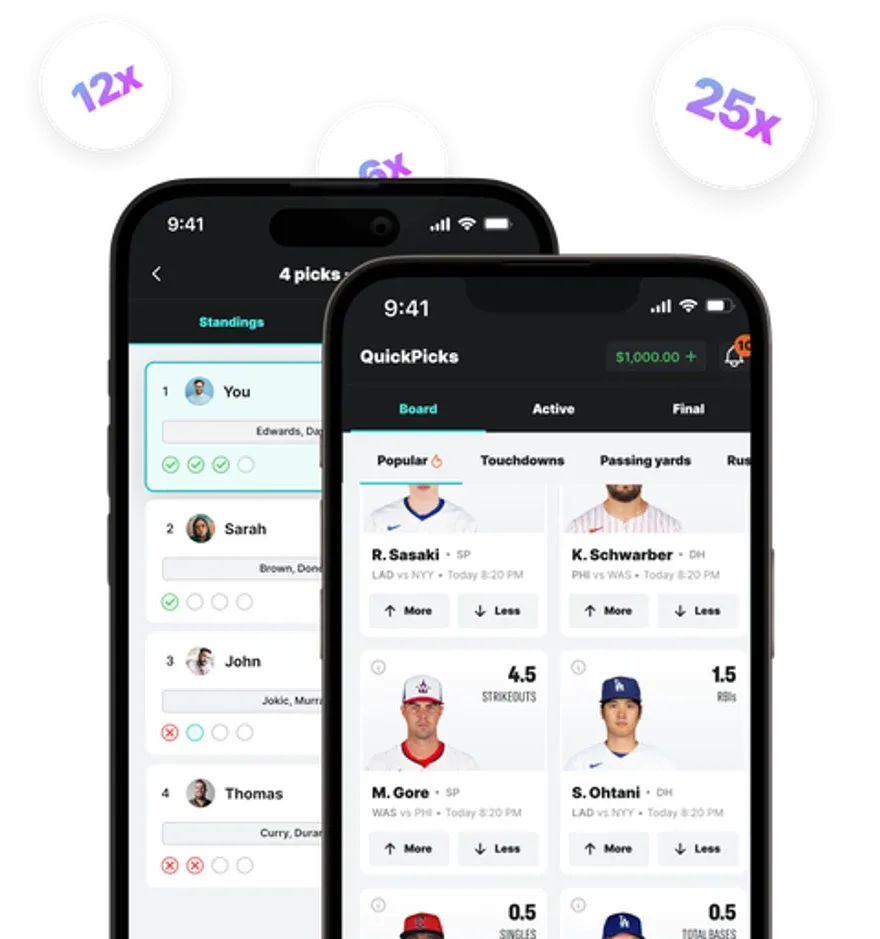
On Splash, that's QuickPicks. Each entry is two or more More or Less calls on player stat lines, drawn from at least two teams, scored against other players' entries. The implied probability sits right on each pick card, so the line's expectation is visible before you commit.
Tiers sits between the two. Splash sorts each slate's players into groups by projected fantasy points. Your lineup takes one from every group, any position. The tiers do the balancing a salary cap would do, without the budget math. Most fantasy points wins.
So which is right? If you want a quick sweat on one night of games, a pick em app fits. If you like building a full lineup, Tiers or a salary cap site fits. If your fun is a season with the same group of friends, look at Survivor, Pick'Em or One & Done instead.
Common mistakes to avoid
Most regrets start at the deposit screen
Choosing by welcome offer. It's a one-time number. Rake and payout rules show up in every contest you'll ever enter.
Skipping the prize table. If you don't know how many places pay, you don't know what you entered.
Assuming the app means the format. An app that works in your state may still limit a format, or leave out college contests. Check the availability page by format.
Using a VPN. It can trip location verification. Disconnect before you log in.
Not knowing your opponent. Peer-to-peer and house-style games can look identical on screen. Read how the contest works before you enter.
Depositing your whole budget on day one. Start small, run a full cycle from entry to withdrawal, and set limits that keep entries in the entertainment column.
Check the menu. Read the prize table. Then play your friends, not the house.
Frequently asked questions
Quick answers before your first deposit
Peer-to-peer sites keep part of the entry fees. DraftKings' 2025 annual report, for example, defines its DFS revenue as the difference between entry fees collected and prizes paid out. You can see that gap yourself by comparing a contest's prize pool with its entry fee times the number of entries. House-style games are different, since you play against the operator.
Don't assume so. Each operator publishes its own availability, and on Splash it differs by format. Splash runs contests in most of the US and in all of Canada except Quebec, and its availability page lists each format and the minimum age, 18+, 19+ or 21+, by state and province.
Five things: the format you want is available where you are, you meet the minimum age, location verification works on your device with any VPN off, you know if you're playing other fans or the house, and you've read how withdrawals work. Then set a budget and use tools like Deposit Limits if the site offers them.
A guaranteed contest promises its prize pool whether or not it fills. If the entry fees collected come in below that guaranteed pool, the operator covers the gap. That gap is the overlay, and the players who did enter share more in prizes than they paid in entry fees. A contest that falls a few entries short may not create one at all.
Real-money contests are only offered where the operator can run them, so the app has to confirm where you physically are. Splash has to confirm where you are, by law, before you can deposit or enter. If the check fails, turn off ad blockers, disconnect from any VPN and avoid secured Wi-Fi networks.