



Every October the group chat lights up. Someone picks a draft night, twelve people say they're in, and by Christmas four of them have stopped setting lineups.
That isn't a commitment problem. It's a format problem.
Fantasy hoops comes in more shapes than most groups realize, from drafts that run all season to contests that end the same night. Pick the wrong one and the league dies in December. Pick the right one and people actually show up.
How fantasy basketball formats differ
Three dials decide everything
The FSGA says it speaks for 85 million fantasy sports players across the US and Canada, and it has been funding FSGA industry research on how those players compete for more than 15 years. That is a lot of people playing a lot of different games under one name.
Strip away the branding and every fantasy basketball format turns the same three dials.
Time. Some formats ask for one draft and nothing else. Others want a lineup decision nearly every night of the season.
Scoring. You can win stat categories, pile up points from a formula, or clear a single bar like 20 points.
Opponents. A season-long league pits you against the same handful of friends all year. A contest can put you against your group, a public field, or both.
Figure out which dial matters most to your group and the choice gets easy.
Nine fantasy basketball formats to try
From draft night to tonight's slate
Five of these are the classic season-long and daily formats. Three run on Splash. The last one is built to outlast everyone's patience, in a good way.
Season-long head to head leagues
Same rival, new matchup every week
This is the format most people picture. You draft a roster before the season, then face one opponent each week. Win the matchup and you bank a win in the standings.
Matchups are scored by categories or by points, depending on the league. When the regular season ends, the teams with the best records move into a playoff bracket, and the bracket crowns the champion.
The appeal is the rivalry. You get a weekly trash-talk target with a name. The cost is attention: lineups, injuries, waiver claims and trades all season long. A head-to-head league is only as good as its least engaged manager, and everyone has met that manager.
Rotisserie & category leagues
Win the stat sheet, not the week
Category leagues judge you on a set of stat buckets instead of one score. The common setup uses eight fantasy basketball categories: points, rebounds, assists, steals, blocks, threes, field goal percentage and free throw percentage. Nine-category leagues add turnovers.
In a head-to-head category league, you try to win more of those buckets than your opponent each week. Rotisserie, or roto, drops the weekly matchup. You're ranked in every category against the whole league across the full season. In a 12-team roto league, first place in a category earns 12 points, second earns 11, and so on down the line.
Roto rewards balance and patience. One bad week doesn't sink you. One neglected category might.
Points leagues
Every stat gets a price tag
A fantasy basketball points league turns every box score into one number. Each stat has a value, and the totals decide the standings.
ESPN's default formula, introduced in 2020, shows how it works in practice: 1 point per point scored, 2 per made field goal, minus 1 per field goal attempt, 1 per made free throw, minus 1 per free throw attempt, 1 per three, 1 per rebound, 2 per assist, 4 per steal, 4 per block and minus 2 per turnover.
Notice what that does. Efficient scorers and defenders climb. Volume shooters who miss a lot slide. Points leagues are easier to follow than categories, but you still need to know how your league prices each stat before you draft.
Best ball leagues
Draft once, then go live your life
Best ball is fantasy for people who love the draft and hate everything after it. You draft a roster, and that's the last decision you make.
There are no waiver claims, no trades, no free-agent pickups and no nightly lineups. Each scoring period, the platform finds the highest-scoring legal lineup from the players already on your team and counts it for you.
That changes what a good draft looks like. A player who posts one monster week still helps, because the system slots that week in automatically. Ceiling matters more than consistency. If your group keeps losing managers to the waiver wire by January, best ball is the fix.
Salary cap daily fantasy
A budget, a slate & no tomorrow
Salary cap daily fantasy is what most people mean by NBA daily fantasy sports. Every player has a price, you get a budget, and you build a new lineup for each slate.
In DraftKings' Classic contests, for example, the cap is $50,000 and your lineup needs players from at least two different teams. You can't afford every star, so the game becomes finding underpriced minutes.
The upside is speed. Results land the same night, and a bad lineup is forgotten by tomorrow. The downside is the field. Big salary cap contests draw serious players with projection tools, so know who you're up against before you enter.
Pick em & player picks with QuickPicks
More or Less, one stat line at a time
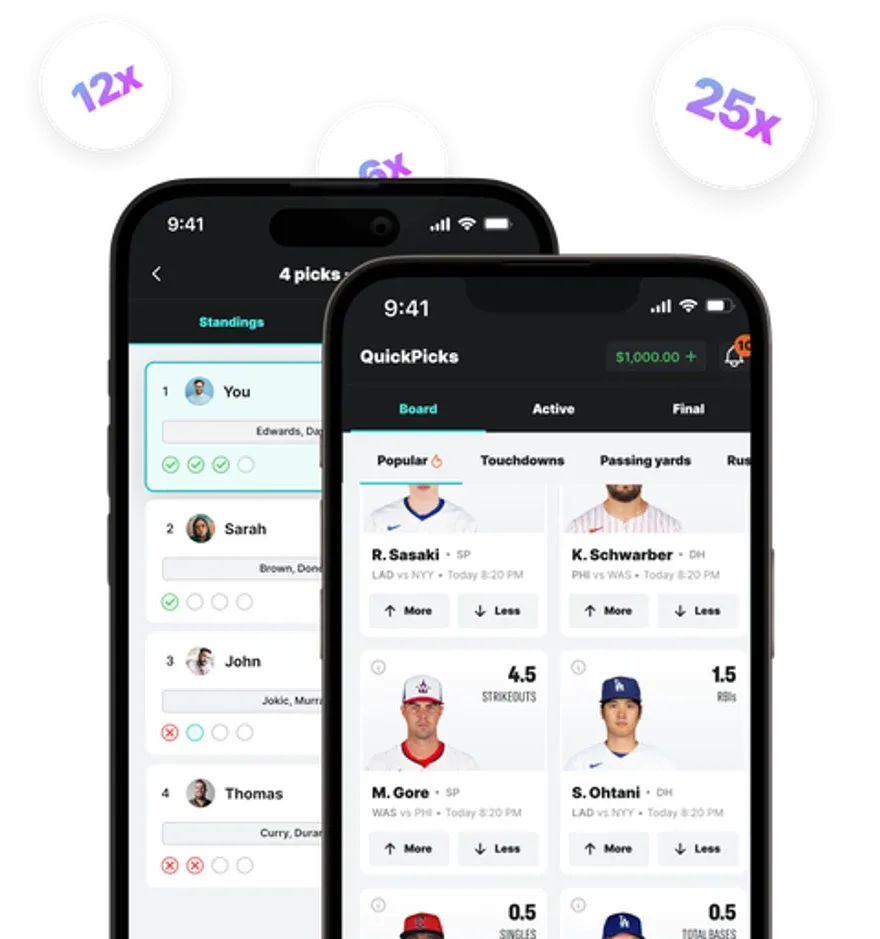
Not everyone wants to build a roster. Some fans just want to call whether a player clears a number tonight. That's the idea behind most NBA pick em games, and it's how QuickPicks works on Splash.
You pick More or Less on player stat lines. An entry needs at least 2 picks, the app currently allows 2 to 5, and your players must come from at least two different teams. You can only use the same player once per entry. Every pick card shows its implied probability, so you know what you're picking before you commit.
You compete against other players, not the house. Building an entry takes about as long as a timeout, which is the point.
NBA tiers contests
One player per tier, no positions
NBA Tiers sits between a draft and a pick sheet. Splash sorts NBA players into six tiers based on performance and expected impact, and you take one player from each tier.
There are no positional requirements. Want to stack bigs? Go ahead. Fantasy points come from the real games, the scoring rules sit in each contest's Rules section, and players who are inactive or injured don't score, so late news matters.
The skill is in the trade-offs. Everyone grabs the obvious star in the top tier. The lower tiers are where one smart pick separates you from the field. The NBA tiers pools guide walks through the research behind those picks.
NBA survivor contests
Twenty points or you go home
NBA Survivor on Splash is a point streak contest. Each day, you pick an NBA player you think will score 20 or more points. Hit and you advance. Miss and you're out.
Day 1 gives you a cushion: two primary players from different teams plus an alternate, and you survive if either primary reaches 20. From Day 2 on, it's one primary and one alternate. The alternate only steps in if your primary doesn't play.
Here's the catch: once you use a player, that player is gone for the rest of the contest. Burn the elite scorers early and the later days get thin fast. Read survivor contests explained for the full rulebook.
Dynasty & keeper leagues
Your roster outlives the season
Keeper leagues let you hold players from one season to the next instead of redrafting from scratch. On ESPN, the league manager sets the keeper limit anywhere from one player up to the full roster, and ESPN notes these leagues are also known as dynasty leagues.
Keep a few players and the draft gets more interesting. Keep everyone and the draft stops being a one-night event. Rookies turn into long-range investments, and trading a veteran for a prospect becomes a real strategy.
This is the deepest commitment on the list. It works for a group that has played together for years and plans to keep going. It does not work for the coworker who joined because the snacks were good.
Daily fantasy basketball vs season-long leagues
Tonight's sweat or a six-month grind
This is the real fork in the road. Season-long formats reward planning: the draft, the waiver wire, the trade you set up in November. Daily fantasy basketball resets every slate, so a bad night costs you one night.
NBA DFS and the other daily formats also fit how the league runs. There are games on most nights of the season, so you can play when you want instead of when your league demands.
Season-long still has the better stories. Nobody remembers a random Tuesday slate. Everybody remembers the trade that won the league. The full breakdown is in daily fantasy vs season-long.
Nine fantasy basketball formats at a glance
| Format | Time you put in | How you win | On SplashOur pick |
|---|---|---|---|
| Head to head | Draft plus weekly lineups | Beat one opponent each week | |
| Rotisserie & category | Draft plus regular roster moves | Rank high in every category | |
| Points | Draft plus weekly lineups | Score the most fantasy points | |
| Best ball | Draft only | Best lineup is picked for you | |
| Salary cap DFS | One lineup per slate | Most points in the contest | |
| QuickPicks | A few minutes per entry | Get your More or Less picks right | |
| NBA Tiers | One lineup per slate | Most fantasy points | |
| NBA Survivor | One pick per day | Last entry standing | |
| Dynasty & keeper | Years | Build a roster that lasts |
Most groups don't have to choose just one. Run the season-long league for the rivalry, then play a daily contest on the nights your team sits.
Which fantasy basketball format fits you
Match the format to your group
Start with the people, not the format. Ask how much time your group will really give this in February, then pick from there.
You live for draft night. Run a head-to-head or roto league, or go full dynasty if the group is already on year five. Do your fantasy basketball draft prep on category value, not name value.
You love the draft and hate the grind. Best ball. One night of work, a season of sweating.
You want something tonight. Splash QuickPicks takes a couple of minutes and settles when the games do. NBA Tiers gives you a full lineup without positions to worry about.
You want a streak to protect. NBA Survivor turns every night into a must-score night.
A few fantasy basketball tips hold up in every format. Check injury news right before picks lock. Don't fall in love with the same three stars everyone else owns. Know your scoring rules better than your opponents do.
Splash contests are available in most of the US and Canada, and formats and minimum ages vary by state, so check where you can play before you set anything up.
Pick your format. Invite the group. See you at tip-off.
Frequently asked questions
Quick answers before tip-off
Best ball and pick-style contests are the easiest starts. Best ball asks for one draft and nothing after it. QuickPicks on Splash asks for two or more More or Less picks on player stat lines, and each pick card shows its implied probability. Category leagues are the hardest place to start, since you're tracking eight or nine stats at once.
Yes. On Splash, QuickPicks, NBA Tiers and NBA Survivor are real-money contests where you play against friends and other fans, not the house. Splash collects entries and pays out winners when contests end. Splash is available in most of the US and in all of Canada except Quebec, and availability and minimum age vary by state and format.
Each category is its own scoreboard. The common eight are points, rebounds, assists, steals, blocks, threes, field goal percentage and free throw percentage, and nine-category leagues add turnovers. In head-to-head, you try to win more categories than your opponent each week. In roto, you're ranked in every category against the whole league across the season.
Six. Splash sorts NBA players into six tiers based on performance and expected impact, and you pick one player from each. There are no positional requirements, so your lineup can lean however you like. Scoring rules sit in each contest's Rules section, and inactive or injured players don't score.
Your alternate steps in. If your primary is ruled out or the game is postponed before tip-off, the alternate replaces that pick automatically. Splash also sends email and push notifications when a primary isn't expected to play, and you can swap manually until the game starts. If a player starts and scores under 20, the entry is eliminated.