


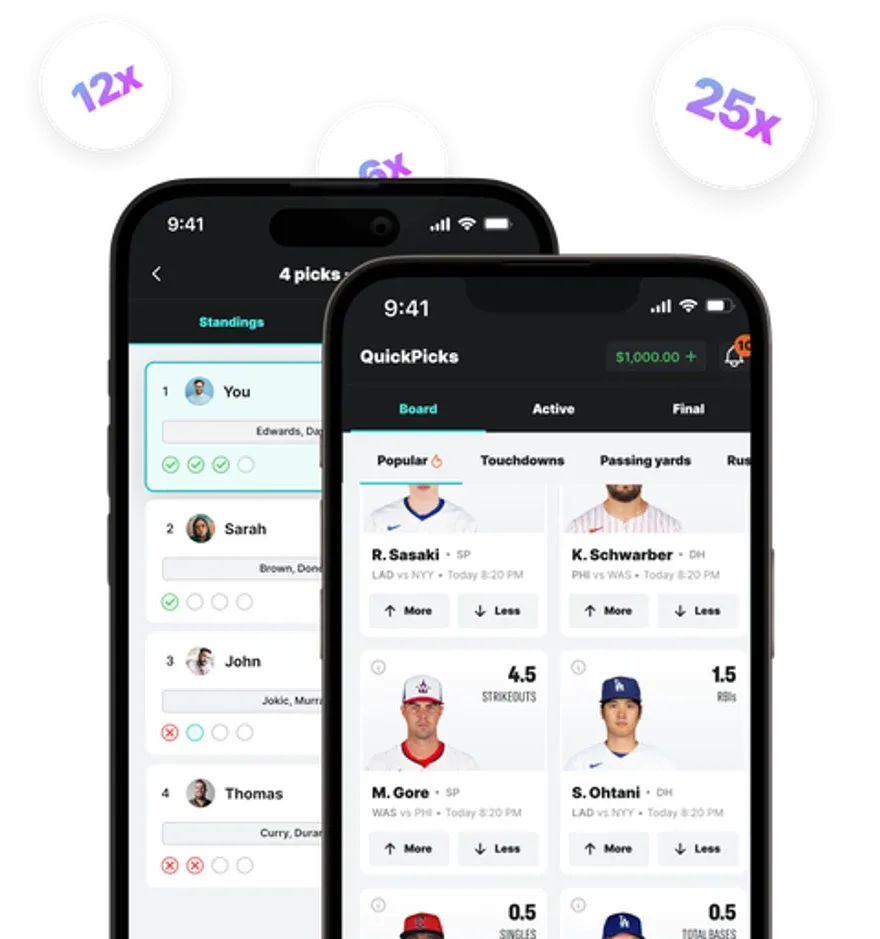
Three tabs, one guard. The first site has him at 24.5 points tonight. The second says 21.8. Your QuickPicks line sits at 23.5.
Most people pick the number they like best and move on. That's backward.
The gap between those numbers is the useful part. It usually comes down to one thing a source knows, or assumes, that the other one doesn't. Learn to read that gap and a projection stops being a verdict and starts being a starting point for your own call.
What NBA DFS projections measure
One number standing in for a range
What you need
- Two projection sources — Any pair that updates on game day. One source is an opinion; two is a check.
- The official NBA injury report — Posted by the league and refreshed through the day.
- A season baseline — Minutes, pace and usage from a stats site like Basketball-Reference.
- Your QuickPicks entry screen — Where the line and each pick's implied probability live.
NBA DFS projections forecast a player's box score for one game. Some sites publish them as fantasy points for salary cap contests. Others break them into stat lines: points, rebounds, assists, threes, combos.
For pick em play, the stat lines are what you want. Fantasy basketball projections in points-per-dollar form answer a salary cap question. You're asking a narrower one: will this stat finish above or below this line?
Every projection is built from the same raw material. Season and recent averages, expected minutes, the opponent and the game environment. Splash's breakdown of player matchups in daily fantasy covers the matchup layer in more depth.
For the baseline layer, Basketball-Reference's NBA season stats page for 2025-26 has team pace, per-game numbers and advanced rates in one place.
Median outcome vs ceiling
The middle of the range, not the top
A single projected number is best read as a typical night. If it's built as a median, the player should land above it about half the time and below it the other half.
A ceiling is different. It's what the player does when the minutes, shots and matchup all break his way. Some research sites publish ceiling and floor projections as a separate product, which tells you how wide the range really is.
For QuickPicks, the middle matters most. You're calling one side of a line, so you want to know where the typical outcome sits relative to it. Ceilings matter more in big-field salary cap tournaments, where the biggest prizes go to the top few lineups.
Minutes, pace & NBA usage rate
Three inputs that move every projection
Minutes come first. A player can't score on the bench, so a projection is really a minutes estimate multiplied by production per minute.
Pace sets how many chances everyone gets. Basketball-Reference defines pace factor as an estimate of possessions per 48 minutes. The 2025-26 range ran from Boston at 94.8 up to Miami at 103.4, with the league average at 99.4. More possessions, more stats to go around.
NBA usage rate tells you who eats. It's Basketball-Reference's estimate of the share of team plays a player uses while he's on the floor. Among players with at least 1,500 minutes in 2025-26, Luka Dončić led at 38.1%. When a high-usage teammate sits, those plays have to go somewhere.
Steps to read projections before you lock
Four checks between you & the submit button
This is the routine. It works for any nba dfs format, but it's built for the way QuickPicks entries come together: a few players, a few stat lines, one call each.
Step 1
Compare NBA fantasy projections across sources
Two sources beat one
Pull two or three NBA fantasy projections for the same player and the same stat. Line them up.
When they agree within a point or so, the number is probably well supported. When they split by three or four points, don't average them and move on. Find out why.
The answer is usually minutes. One source assumes a starter is back, the other doesn't. One expects a blowout and shorter run for the stars, the other projects a close game. The disagreement tells you exactly which piece of news decides the pick.
Step 2
Check NBA DFS projections today against the injury report
The league's report outranks last night's number
A projection is only as fresh as the news behind it. So check NBA DFS projections today against the league's own injury report, not against a screenshot from last night.
For 2026-27, the NBA requires teams to list a participation status by 5 p.m. local time the day before a game, or by 1 p.m. local on game day for the second night of a back-to-back. On other game days, teams also file a game-day report between 11 a.m. and 1 p.m. local, or 8 to 10 a.m. for tip-offs at 5 p.m. or earlier. The league updates the report through the day.
Re-check every player in your entry after that window, and again before tip.
Step 3
Turn projections into NBA DFS picks
Your number minus the line equals a reason
Splash's QuickPicks rules describe each line as a statistical projection. So you're comparing your number to Splash's number.
A small gap is noise. A real gap, backed by a minutes change, a pace-up matchup or a usage bump, is a pick. Good nba dfs picks today come from those gaps, not from the biggest names on the board.
Then check the implied probability on the pick card. Picks above 50% lower your multiplier and picks below 50% raise it. That's the trade: a likelier call pays less.
Step 4
Lock your QuickPicks entries
Two teams, no repeats, then submit
Build the entry on the Splash QuickPicks game page or in the app. You need at least two picks, players from at least two teams, and no player twice.
Watch for correlation. Picks that tend to rise together can lower your multiplier under the QuickPicks rules, and your exact multiplier and potential payout show before you submit. Read them.
Timing matters too. Each projection is meant to come off the board when its game starts, and the rules treat one left up after tip as a board error. Submit before your earliest game tips. Promotions come and go, and none is promised here; if a deposit promo offer is running when you fund your account, the app shows it.
Watch out
A projection posted the night before can miss a game-day status change. If a player's status moved after the projection was published, treat the old number as stale until the source updates it.
Tip
A player who ends up not playing isn't scored as a wrong pick in QuickPicks. If that leaves your remaining picks all on one team, the entry is voided and the entry fee refunded.
NBA DFS ownership projections & when they matter
Crowd math for big fields, not small groups
NBA DFS ownership projections estimate how many lineups in a contest will roster a given player. They exist because of salary cap tournaments.
In a big field, a popular player who busts drags down a huge slice of the room at once, and the lineups that skipped him climb. Splash's advanced DFS guide ties ownership projections to finding contrarian plays in large-field tournaments.
QuickPicks works differently. You're grouped only with entries that made the same number of picks, and those groups have a ceiling. Your opponents' picks stay hidden until the contest is fully matched and locked.
And the payout runs on your own entry. Go perfect and you receive your full displayed payout. If nobody goes perfect, the most correct picks win.
So the flip: in QuickPicks, being different isn't a strategy. Being right is.
Finding NBA DFS value plays
Value is a gap, not a price tag
In salary cap contests, value usually means projected fantasy points per dollar of salary. A cheap bench player thrust into 30 minutes is the classic case. Splash's guide to advanced DFS strategies covers how that plays into roster building.
QuickPicks has no salaries, so NBA DFS value plays look different. Value is a line that hasn't caught up to the news.
Where those usually show up:
- A teammate ruled out. A high-usage player sits, and his plays and minutes move to someone else.
- A pace-up game. Two fast teams mean more possessions for everyone on the floor.
- A role change. A new starter, or a bench player whose minutes have climbed over the last few games.
- A late status change. News that broke after most projections were published.
Then weigh the gap against the implied probability on the card. A big gap on a pick that's already priced as likely may not be worth the multiplier hit.
Common mistakes to avoid
Five ways a good projection goes wrong
Projections don't usually fail you. The way you read them does.
Treating the number as a promise. A projection is the middle of a range. A player projected at 22 points scores 15 on some nights and 30 on others.
Using a stale number. If it was published before the game-day injury report, it may be missing the news that matters most.
Ignoring minutes. A lot of big misses trace back to a minutes surprise: foul trouble, a blowout, a rest night on a back-to-back.
Stacking teammates for a bigger payout. Correlated picks can lower your multiplier in QuickPicks. Pair them because you believe both calls, not because you expect a bonus.
Chasing ceilings in nba pick em. A ceiling projection is built for tournaments. On a More or Less call, the typical outcome is what decides it.
Read the median. Check the report. Then make the call.
Frequently asked questions
Projection questions, answered fast
Accurate enough to be useful, never accurate enough to trust blindly. A projection estimates a typical night, so single games regularly land well above or below it, and accuracy varies by source and by stat. Minutes are often the biggest swing factor. Track a source against the lines you actually play for a few weeks before leaning on it.
Yes, more directly than in salary cap play. Splash's QuickPicks rules describe each line as a statistical projection, so every More or Less call is your read against Splash's number. Your own projection, built from minutes, pace, usage and the injury report, is what tells you which side of the line you believe.
Twice on game day. First, after the NBA's game-day injury report window, which runs 11 a.m. to 1 p.m. local time, or 8 to 10 a.m. for tip-offs at 5 p.m. or earlier. Second, shortly before your earliest game tips, because the league updates the report through the day and late scratches happen.
Usage rate estimates the share of a team's plays a player uses while he's on the floor, counting shots, free throw trips and turnovers. Basketball-Reference publishes it for every player. A high number means the offense runs through him, which is why a high-usage player sitting out shifts projections for his teammates.
No. Under Splash's QuickPicks rules, a player listed as out or who logs 0 minutes is a DNP, and a DNP is never an incorrect pick. If the picks left over all come from one team, the entry is voided and the entry fee refunded. A player who starts and gets hurt early is scored as usual, with no injury protection.