



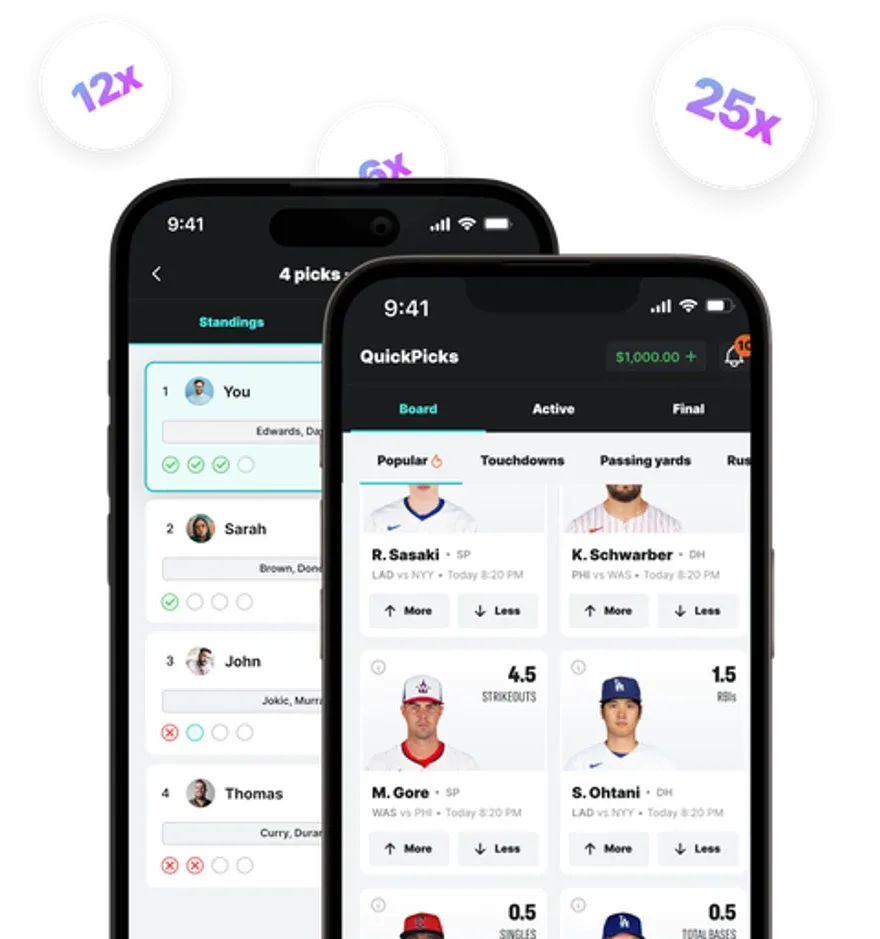
It's 6:40 p.m. and a ten-game slate tips in twenty minutes. You have $50,000 of pretend salary, a center you love priced like a superstar, and a lineup sitting $1,300 over the cap.
Your buddy on the other end of the couch already entered. Three players. More or Less on each one. Done in four minutes.
You're both playing NBA daily fantasy. You're just solving different puzzles. Here's where salary cap contests and pick em entries like QuickPicks split, and which one suits the way you actually watch basketball.
Quick verdict on pick em vs salary cap contests
Fewer moving parts, same basketball brain
Our pick: QUICKPICKS (NBA PICK EM)
QuickPicks fits most nights
For most fans, QuickPicks is the better nightly NBA DFS contest: a handful of calls, a payout you can see before you submit, and capped groups instead of giant fields. Salary cap contests still win if you love building a full roster and out-thinking a crowd.
Scored 0 to 10 on each criterion, by the Splash editorial team
| Criterion | QuickPicks (NBA pick em)Our pick | Salary cap contests |
|---|---|---|
| Time to build an entry | 9/10 ✓ | 4/10 |
| Research you need | 8/10 ✓ | 5/10 |
| Payout shown before you submit | 9/10 ✓ | 6/10 |
| Size of the field you face | 8/10 ✓ | 4/10 |
| Room to build a full-slate roster | 4/10 | 9/10 ✓ |
| Cushion when one player flops | 5/10 | 7/10 ✓ |
| Total | 43/60 | 35/60 |
Salary cap is the version most people picture when they hear nba dfs: a budget, a roster grid and a slate full of price tags. Pick em strips that down to the calls themselves.
That's the real trade. Salary cap rewards roster construction. Pick em rewards being right about specific players on a specific night.
Where QuickPicks wins
- No budget math, no position slots, no optimizer
- Your multiplier and potential payout show before you submit
- You're matched with entries that made the same number of picks, in capped groups
- A player who doesn't suit up isn't scored as a miss
Where salary cap contests win
- Eight or nine roster spots, so one quiet night can be covered by the rest of the lineup
- Cash games where roughly half the entries get paid
- A full-slate pricing puzzle for players who enjoy building from scratch
New to the split? Splash's explainer on how daily fantasy works covers the salary cap basics in a few minutes.
How salary cap NBA DFS lineups work
A budget, a grid & a slate of price tags
Every player on the slate gets a salary. You fill a fixed set of roster slots, and the total has to land at or under the cap.
On DraftKings, classic NBA lineups get $50,000 for eight spots: PG, SG, SF, PF, C, a guard, a forward and a utility slot. FanDuel gives you $60,000 to fill nine spots. Both sites adjust their roster formats from time to time, so read the current contest rules before you build.
Picking good players isn't the hard part. Everyone can name the good players. The stars cost so much that nba dfs lineups live or die on the cheap guys you squeeze in next to them.
That's why salary cap players obsess over points per dollar, minutes and late news. If you want the deep end of that pool, Splash's guide to advanced DFS strategies walks through stacking, multi-lineup builds and contest selection.
Why NBA DFS optimizer tools matter there
Math problems love software
A salary cap lineup is a constrained math problem. A huge number of legal roster combinations, one budget, position rules stacked on top.
An NBA DFS optimizer solves it for you. You feed it projections, and it returns the highest-projected lineup that fits the cap. Research sites sell them site by site. RotoWire, for one, runs separate NBA lineup optimizers for DraftKings, FanDuel and other sites.
Here's the catch. If plenty of players feed similar projections into similar tools, their lineups start to look alike. The optimizer gets you a legal, sensible roster. It doesn't get you a different one.
NBA DFS ownership & field size
The crowd is part of the contest
Ownership is the share of entries that roster a given player. Splash's own DFS strategy guide frames it the same way: the percentage of players who chose that athlete.
NBA DFS ownership matters because of field size. RotoWire's primer splits contests in two. In cash games, about half the entries finish in the money, so safe, high-floor players make sense. In tournaments, payouts climb with your finish and one lineup takes the grand prize, so you need to look different from the crowd.
That's when the popular play turns into a problem. If a star sits in a huge share of lineups and he busts, everyone sinks together, and the lineups that faded him climb. If he hits, you're chasing.
Big-field salary cap play is a crowd-reading contest as much as a basketball one.
How NBA pick em entries work
Call the line, skip the budget
NBA pick em flips the job. There's no salary and no roster grid. Each pick is a player, a stat line and a call: More or Less.
Plenty of pick em apps run on that idea. Splash's version is QuickPicks, its player pick'em format, and the Splash app store listing names NBA among the leagues it covers, alongside the NFL, MLB, NHL and others.
The rules on the Splash QuickPicks game page are short. An entry needs at least two picks, players from at least two different teams, and no player more than once. Every pick card shows its implied probability, so you know how likely the call is before you commit to it.
How QuickPicks entries differ
Peer-to-peer, grouped by pick count
You aren't playing against the house. Once you submit, Splash matches your entry with other players who chose the same number of picks, and you compete against them.
Those groups have ceilings, and the ceiling depends on your pick count. You're in a contained room, not an open-ended tournament. Your opponents' picks stay hidden until the contest is fully matched and locked, so there's no peeking.
Two more rules change how an entry feels. Correlation lowers your multiplier, so picks that tend to rise together, like one player's assists and a teammate's points, can pay less as a pair. And a player who doesn't play isn't marked wrong. The entry is rescored around the picks that remain, and if those are all from one team, it's voided and the entry fee is refunded.
Scoring & payouts compared
Points per stat vs right or wrong
Salary cap contests turn the box score into fantasy points. DraftKings' classic scoring, as RotoWire's primer lays it out, gives 1 point per point scored, a 0.5 bonus per made three, 1.25 per rebound, 1.5 per assist, 2 per steal or block, minus 0.5 per turnover, plus 1.5 for a double-double and 3 for a triple-double. FanDuel's own scoring page lists 1.2 per rebound, 1.5 per assist, 3 per steal or block and minus 1 per turnover, with no double-double bonus.
QuickPicks doesn't care how many fantasy points a player piles up. It cares whether the one stat you picked finished above or below the line.
QuickPicks vs salary cap NBA contests, head to head
| QuickPicksOur pick | Salary cap contests | |
|---|---|---|
| What you pick | More or Less on player stat lines | A full roster under a budget |
| Budget | None | $50,000 on DraftKings, $60,000 on FanDuel (classic NBA) |
| Roster rules | 2+ picks, players from 2+ teams, each player once | 8 slots (DraftKings) or 9 (FanDuel), with position rules |
| How you score | Correct calls | Fantasy points from box score stats |
| Who you face | Entries with the same pick count, in capped groups | Anything from head-to-head games to large tournaments |
| How you win | Go perfect, or have the most correct picks if nobody does | Finish high enough in the standings to cash |
| If a player sits | Not counted as a wrong pick | That roster spot produces no stats |
| Payout shown up front | Your multiplier and potential payout before you submit | Your share depends on where you finish |
Payouts split the same way. In a salary cap tournament, the money follows your finish, and the top of the table pays the most. In cash games, about half the field gets paid.
QuickPicks pays off your own entry. Your multiplier comes from the combined implied probability of your picks: picks above 50% pull it down, picks below 50% push it up. Go perfect and you receive your full displayed payout, guaranteed, as soon as your picks are final. If nobody in the contest goes perfect, the entry with the most correct picks wins its full displayed payout.
Promotions come and go, and none is promised here. If a deposit promo offer is running when you sign in, the app shows it.
Research you need for each
Same homework, different final exam
Good NBA DFS advice for either format starts in the same three places: minutes, role and matchup. What you do with that homework is where the formats part ways.
Salary cap players need a priced view of the whole slate. Pick em players need a sharp view of a few specific stat lines.
NBA DFS projections
A median, not a promise
NBA DFS projections are a site's estimate of what a player will produce on a given night. Salary cap players read them as fantasy points per dollar. Pick em players read them stat by stat and hold them up against the line.
Start with the baseline. Basketball-Reference's NBA season stats page for 2025-26 lists MVP Shai Gilgeous-Alexander at 31.1 points, 4.3 rebounds and 6.6 assists a game. That's last season's average, not tonight's forecast. Minutes, matchup and the injury report move it.
NBA DFS value plays also mean different things in each format. In salary cap, value is a cheap player projected well above his price. In QuickPicks, value is a line sitting meaningfully away from where your own projection lands.
NBA DFS picks by slate
Big slates & small slates play differently
Most NBA DFS picks content is written for one night's slate, because that's how the contests run. The size of that slate changes the job.
On a big salary cap slate you get more cheap options and more ways to stand apart, plus a lot more news to track. On a two- or three-game night, everyone shops from the same short list, and lineups start to converge.
In QuickPicks, slate size mostly changes your menu of stat lines. You still need only a few calls you believe in, and nobody is grading you on how unique they are.
Which daily fantasy basketball format fits you
Pick the puzzle you actually enjoy
Daily fantasy basketball isn't one game. It's two, and the right one depends on your night.
Play salary cap contests if you like building rosters, you'll track news right up to tip, and you want to beat big fields by reading the crowd.
Play QuickPicks if you have a few strong opinions on specific players, you want to see your payout before you submit, and you'd rather face a capped group of players who made the same number of picks.
Most people who watch the NBA every night already carry the second kind of opinion. He's going to feast on that frontcourt. No way he plays 34 minutes on the second night of a back-to-back. QuickPicks turns those hunches into an entry.
Availability and minimum age vary by state and by format, so check where you can play first. Splash runs in most of the US and in all of Canada except Quebec.
Make your calls. Check the multiplier. Submit before tip.
Frequently asked questions
Quick answers before tip-off
Easier to build, not easier to win. A QuickPicks entry takes a few calls instead of a full roster under a cap, so the research load is lighter. But every pick has to hit for the perfect payout, and your multiplier reflects how likely your picks are. Salary cap gives you more roster spots to absorb a bad night. Different skills, not a shortcut.
No. An optimizer solves the salary cap puzzle: the best projected roster that fits a budget and position rules. QuickPicks has no budget and no positions. You need a view on each stat line, a check of the injury report, and a look at the implied probability on each pick card. A projection source helps. Lineup-building software doesn't.
Sometimes. A miss takes your entry out of the guaranteed perfect payout. Under Splash's QuickPicks rules, though, if nobody in your contest goes perfect, the entry with the most correct picks wins its full displayed payout, and tied entries split the prize. A player who doesn't play isn't counted as a wrong pick either.
At least two, from at least two different teams, with each player used once. The app shows how many picks you can add on your slate while you build. Your pick count also decides which group of entries you're matched into, so a 3-pick entry only faces other 3-pick entries.
No. QuickPicks is peer-to-peer. Your entry is matched with other players who made the same number of picks, and you compete against them, not against Splash. Opponents' picks show once the contest is fully matched and locked, and a perfect entry is paid as soon as all of its picks are final.
Play on the go
Take Splash Sports with you
Make your picks, track live scoring, and cash out instantly from anywhere. The Splash app puts every contest (Survivor, QuickPicks, Pick'Em and brackets) in your pocket, free on iOS and Android.