



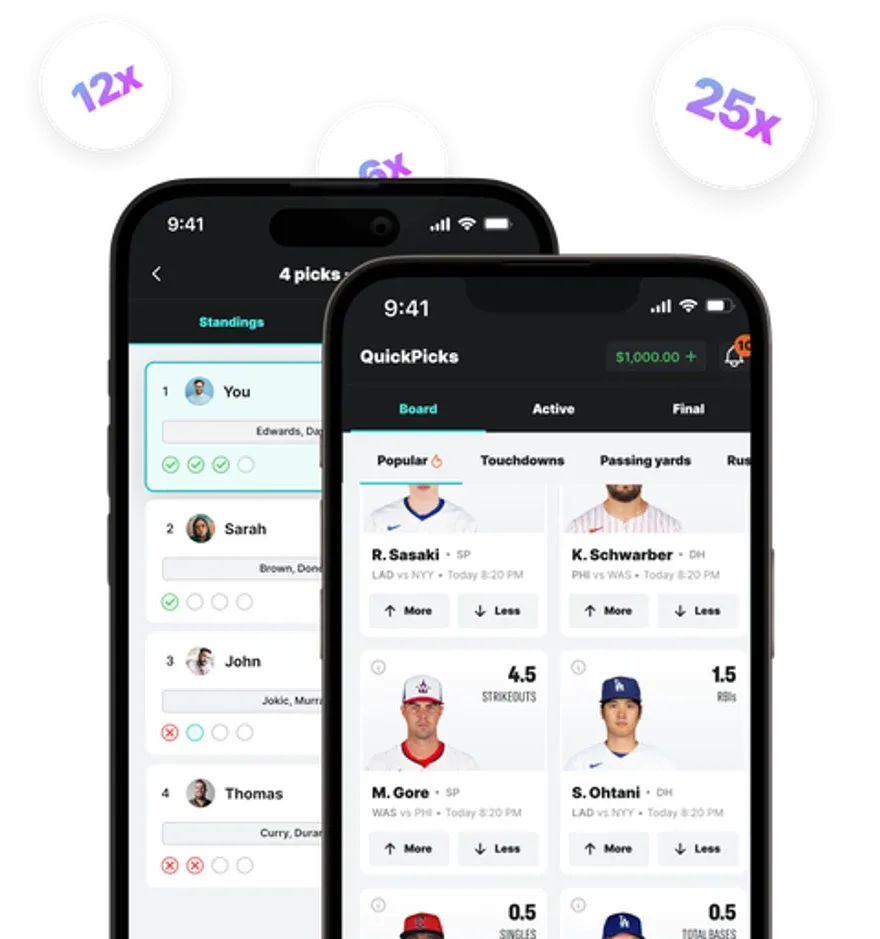
You've got two picks you love and a third you're talking yourself into. The star's points line looks low. His team played last night. The injury report hasn't changed since lunch.
That third pick is where entries die.
The tips below are built for QuickPicks, Splash's More or Less format. None of them is a sure thing. Each one is a small edge, and small edges add up over a season of slates.
How NBA DFS works on QuickPicks
More or Less, one stat line at a time
Most NBA DFS games hand you a salary cap and a roster to fill. QuickPicks skips both. You look at a player's stat line, say points or rebounds, and call More or Less.
The rules are short. An entry needs at least two picks, from players on at least two different teams, and each player can appear only once. The QuickPicks FAQ currently lists 2 to 5 picks per entry. Every pick card shows its implied probability, so you know what you're picking.
Scoring in the FAQ is points-based. A correct call earns 1 point, a tie or a DNP earns 0.5, and a miss earns 0. You compete against other players in your contest, not the house.
The board changes every day, which makes nba dfs today a different puzzle than yesterday's. New matchups, new injuries, new lines. That's the appeal.
Ten NBA DFS tips for smarter entries
Small edges that add up over a season
These ten tips cover the calls behind good nba dfs picks: who plays, how long, against whom and at what speed. Treat them as an nba dfs strategy checklist, not a script.
For the theory underneath, Splash's guide to advanced daily fantasy strategies is the next read. For team pace and league trends, start with Basketball-Reference's current NBA season summary.
Check the NBA injury report before lock
Know who's playing before you pick
The most useful document in NBA DFS is free. The NBA requires teams to report each player's status by 5 p.m. local time the day before a game, then file again between 11 a.m. and 1 p.m. local time on game day. The official nba injury report on official.nba.com updates continually through the day.
Read it twice: once when you start building and once right before you submit. A starter ruled out doesn't just remove one name from the board. It hands minutes and shots to teammates whose lines may not have caught up yet. That gap is where good entries come from.
Follow projected minutes, not names
Minutes are the stat behind every stat
Points, rebounds and assists all start with time on the floor. A role player who jumps from 24 minutes to 34 because a starter sits has more chances at every counting stat, whatever the name on the jersey.
Big names get the attention. Minutes get the stats.
Before you take a More, ask three questions. Who's out tonight? Who starts in their place? Is anyone coming back from injury on a minutes limit? Recent box scores show who's actually getting the run. A projection that ignores a rotation change is already out of date.
Fade the second night of a back to back
Tired legs & late news hit night two
An nba back to back means games on consecutive nights. Teams average 14.2 of them in 2026-27, per the NBA's schedule release, so you'll see plenty.
The second night is where trouble hides. Teams have until 1 p.m. local time on game day to report status for that game, later than the usual 5 p.m. deadline the day before. And the NBA's Player Participation Policy, adopted in 2023, allows pre-approved back-to-back restrictions based on a player's age, career workload or serious injury history.
To fade means to lean away. On night two, be slower to take More on veteran stars and heavy-minute starters.
Pair players from the same fast-paced game
More possessions, more stats to share
Pace is Basketball-Reference's estimate of possessions per 48 minutes. More possessions means more shots, rebounds and assists for everyone on the floor. The spread between teams is real: in 2025-26, Miami averaged 103.4 possessions per 48 and Boston 94.8.
When two up-tempo teams meet, More picks on both sides look better. QuickPicks already requires players from at least two teams, so one player from each side of a high-pace matchup fits the rules neatly.
The flip side is correlation. If that game crawls, both picks feel it.
Use usage rate to break ties
When two picks look equal, follow the ball
Usage rate, per Basketball-Reference, estimates the percentage of team plays a player uses while on the floor. In plain terms: how often the possession ends with him.
When you're stuck between two points lines that look about the same, take the player whose team runs more through him. More plays means more shots, and more shots means more chances to clear a points line.
It cuts the other way too. A low-usage scorer needs a hot shooting night to hit More, and shooting swings from game to game. Usage also climbs when a teammate sits, so check it next to the injury report.
Mix stars with value picks
Don't build an entry of only headliners
Stars carry the headlines, and their lines usually reflect it. Everyone in your contest knows what a superstar averages.
Value picks are where the crowd isn't looking: a role player whose minutes just jumped, a backup stepping into a starting job, a rebounder facing a team that misses a lot of shots.
Use the implied probability on every QuickPicks card to compare them. Pair a star line you trust with one or two value picks you've actually researched. Your entry stops depending on one famous name having an average night, and you're no longer making the same entry as everyone else.
Lean on home court in close calls
Home teams still win a bit more
Home court is real, but it's small. In 2025-26, home teams went 679-546 in the regular season, about 55%, per Basketball-Reference's expanded standings.
That's an edge, not a rule.
Use it the way you'd use a tiebreaker. When two picks look equal on minutes, matchup and usage, take the player at home. Don't let it override a bad matchup or a minutes problem. Home court is the last thing you check, not the first, and it never rescues a pick the injury report already sank.
Avoid stacking one blowout risk
Lopsided games bench starters early
When a game gets out of hand, coaches tend to pull starters in the fourth quarter. That's great news for the bench and bad news for your More on a starter's points.
The trap is correlation. Take three starters from a heavy favorite, and one rout can sink all three picks at once. Spread your entry across games instead.
If you love a lopsided matchup, use it on purpose. A Less on a starter who could sit the fourth quarter is the same read pointed in the right direction.
Set an entry budget & stick to it
Pick your number before you see the board
Decide what tonight's entries cost before you open the app, and stop when you hit it. A budget turns a bad night into a normal one.
The biggest budget mistake is chasing. A late miss stings, and the next slate is right there. Treat entry fees as entertainment money, not income, and keep your entry sizes steady instead of doubling up to win it back.
If play stops feeling like fun, the Splash site footer links to its Responsible Gaming page and to Birches Health for support.
Track your results by pick type
Your notes beat your memory
Memory is a terrible scorekeeper. You'll remember the 40-point night you called and forget the five Mores that missed by a rebound.
Keep a simple log: player, stat, More or Less, home or away, rested or second night, result. After a few weeks, patterns show up. Maybe your Less calls on rebounds hit and your points Mores don't.
That's nba fantasy picks data no projection site can give you, because it's about your own decisions. Cut the pick types that lose and lean on the ones that win.
Daily fantasy basketball on QuickPicks vs salary cap DFS
Same sport, a very different puzzle
Classic dfs basketball works like a draft with a budget. You build a roster under a salary cap, your players earn fantasy points for stats like points, rebounds, assists, steals and blocks, and the highest total wins. Splash's knowledge base describes the format the same way.
QuickPicks drops the cap and the roster. You make fantasy basketball picks one stat line at a time, More or Less, from at least two teams. There's no fitting a star under a budget.
That changes the skill. Salary cap daily fantasy basketball rewards roster construction. QuickPicks rewards reading individual lines, which is why minutes, injuries and pace carry so much weight in the tips above.
QuickPicks vs salary cap DFS vs NBA Tiers
| QuickPicksOur pick | Salary cap DFS | NBA Tiers | |
|---|---|---|---|
| What you pick | More or Less on player stat lines | A full roster of players | One player from each of six tiers |
| Budget | None | Stay under a salary cap | None, the tiers do the balancing |
| Roster rules | At least two teams, each player once | Roster must fit under the cap | No positional requirements |
| Scoring | 1 point per correct call | Fantasy points for real stats | Fantasy points, per contest rules |
Like the draft feel without the spreadsheet? Splash's Tiers format sits in the middle. The NBA tiers pools guide walks through how it works.
Where you can play QuickPicks
Most of the US & Canada, with caveats
Splash offers legal play for real money in most of the US and Canada, including all of Canada except Quebec. Each format has its own column on the availability chart, though, so a state where you can play Survivor isn't automatically a state where you can play quickpicks.
Minimum age varies by state too: 18+, 19+ or 21+. The quickest way to check is the where you can play page, which lists every state and province by format.
Wherever you are, Splash has to verify your physical location before you deposit or join a contest. Turn off VPNs and ad blockers before you log in.
Check the report. Watch the minutes. Build the entry.
Frequently asked questions
Quick answers on QuickPicks
At least two. The QuickPicks FAQ currently lists entries of 2 to 5 picks, with more options coming. Your players must come from at least two different teams, and each player can appear only once per entry, so you can't take the same star's points and rebounds together.
Yes, under the points-based scoring in the QuickPicks FAQ. A miss earns 0 points, and the player with the most points in the contest takes first place, with ties splitting the prize evenly. A perfect entry is still the cleanest path, since perfect entries pay the moment your picks resolve.
It depends on where you are and which format you play. Splash offers legal real-money play in most of the US and in all of Canada except Quebec, but QuickPicks availability and minimum age vary by state. Check the availability page, and expect location verification before you deposit or join.
If they started the game, they're scored as usual, even if they only played a few seconds. A player who doesn't play at all earns 0.5 points. If DNPs leave the rest of your entry with players from only one team, the entry is voided and refunded.
Yes. Every pick card shows its implied probability, so you can see how likely a result is before you take a side. Use it to compare picks, not as a promise. A pick with a 70% implied probability still misses about three times in ten.