



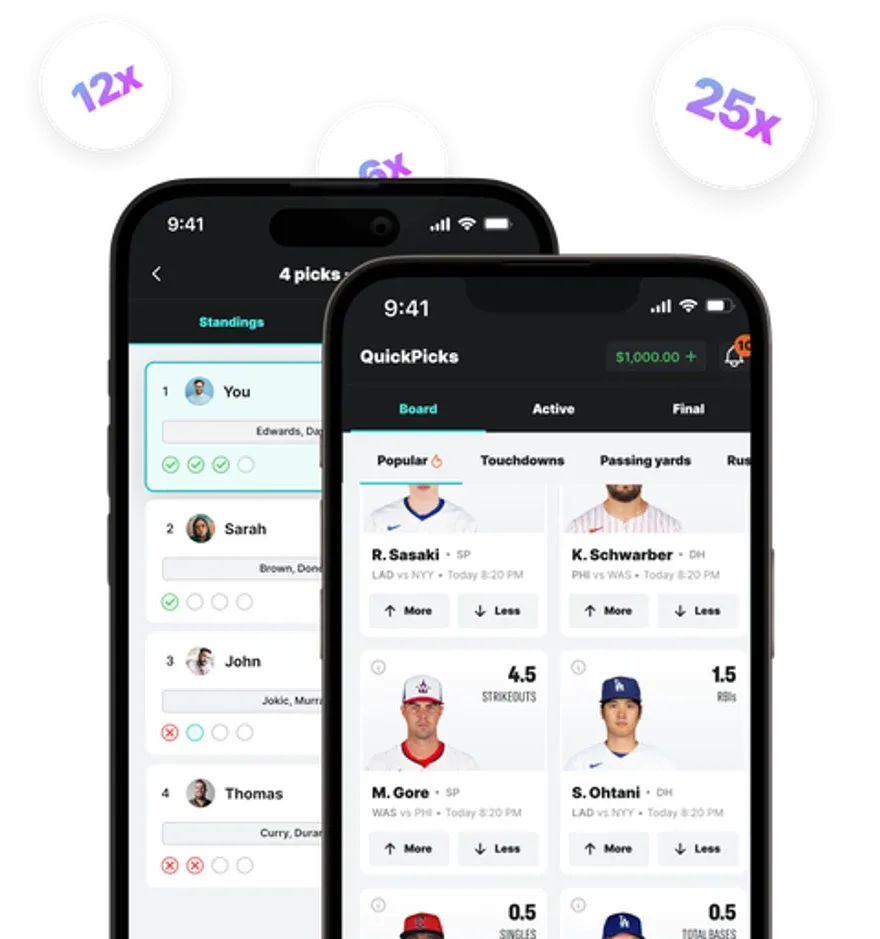
You built the entry at lunch. Four picks, two teams, a rebounding line you loved.
Then 6:15 p.m. rolls around and somebody in the group chat posts a screenshot. Your center is questionable with a sore ankle, and the backup who would soak up those minutes is sitting right there on the slate.
That moment can matter more than any stat model. This guide covers how to read the official report, when it updates and how to rework an entry before you submit it.
What the NBA injury report tells you
One PDF, five statuses, a lot of signal
What you need
- The official report — The league's injury report page on official.nba.com, which posts every update as a PDF.
- One news feed you trust — A team beat writer or a site that timestamps every update.
- Your entry, not yet submitted — Build it early if you like, but hold the submit until the late news is in.
- A Splash Sports account — Signed in and location verified, since verification is required before you join a contest.
If you've ever typed "what is NBA injury report" into a search bar, here's the short answer. It's the league-mandated list of every player whose participation in a game may be affected. Teams must report injuries, illnesses, other medical conditions and rest, for every game.
Each row on the nba injury report shows the game date, tip time in Eastern, the matchup, the team, the player, a current status and a reason. The reason column is where the good stuff hides. You'll see entries like "Injury/Illness - Left Calf Strain," "G League - Two-Way," "Not With Team" and, on some nights, plain "Rest."
For daily fantasy basketball, that one document answers the only question that matters before you pick: who is actually going to be on the floor? If you're new to the format, Splash's guide to how daily fantasy works covers the basics first.
Out, doubtful, questionable & probable
A scale from gone to good to go
The official report uses five statuses: Out, Doubtful, Questionable, Probable and Available. Read them as a scale.
Out means the player won't play. Move on.
Doubtful leans toward sitting. Treat the player as gone unless the team says otherwise.
Questionable is the genuinely uncertain tier, and it's where late news matters most.
Probable leans toward playing, and Available means the team has cleared the player.
One more label to know. If a team hasn't filed yet, its rows read "NOT YET SUBMITTED." That isn't good news or bad news. It's no news.
Game time decision tags
The status that isn't on the sheet
You won't find "game time decision" anywhere on the official report. It's shorthand from coaches, reporters and fantasy sites for a player whose status won't be settled until warmups or close to tip.
On fantasy apps and news feeds, you'll see it shortened to NBA GTD. Some outlets use their own labels too. ESPN's injury table, for example, tags many short-term absences "Day-To-Day" and adds a dated note on the latest report.
Here's the flip. A GTD tag feels like a warning. For a DFS player, it can be an opportunity, because plenty of people in your contest won't wait around for the answer.
Steps to check injuries before you lock
Four checks between lunch & tip-off
Injury work in NBA DFS isn't one look. It's a routine that starts the afternoon before and ends when you submit your entry. Run these four checks in order.
Step 1
Read the NBA injury report today
Know the deadlines teams work against
Open the nba injury report today on the league's official page, and know when teams have to file. By 5 p.m. local time the day before a game, teams must list a status and a reason for any player whose participation may be affected. For the second night of a back-to-back, that deadline moves to 1 p.m. local time on game day.
On other game days, teams also submit a game-day report between 11 a.m. and 1 p.m. local, or between 8 and 10 a.m. for tip-offs at 5 p.m. or earlier. After that, the league says reports are updated on a continual basis. When we checked the page on Oct. 30, 2026, it was listing a fresh PDF every 15 minutes.
Step 2
Follow NBA injury news into tip-off
News moves before the PDF does
The PDF is the official record. NBA injury news from beat reporters can land first, especially after shootaround and pregame warmups.
Keep two tabs open: the official report and a feed with timestamps, like the ESPN injuries page, which lists each player's status, an estimated return date and a dated note on the latest news. When the two disagree, trust the newer timestamp, then confirm it on the next official PDF.
Step 3
Shift your NBA DFS projections
Move the minutes before you move the picks
When a player goes from questionable to out, don't just delete that pick. Ask where the minutes go.
A starter's minutes don't vanish. They get split among the backup at that spot, the next guard or wing up, and sometimes a starter who simply plays longer. The player inheriting the most minutes is the first one to look at, and their stat lines may not have caught up to the news yet.
Step 4
Recheck your NBA pick em entries
One last pass before the first tip
Before you submit, reread every pick. If you play NBA pick em on QuickPicks, you're calling More or Less on player stat lines, with at least two picks from players on at least two different teams.
Know how QuickPicks scores injuries. A player who starts is graded as usual, even if they leave after a few seconds. A player who doesn't play earns half a point. If a DNP leaves your remaining active picks all on one team, the entry is voided and refunded.
Tip
Playing NBA Survivor on Splash? You get an email and a push notification if your primary pick isn't expected to play, and you can swap that player manually until their game starts. Skip the swap and your alternate is used automatically.
Watch the starts
A questionable player who starts and exits early still counts in QuickPicks. The half-point safety net only covers a true DNP.
NBA load management & rest days
Healthy players sit too, on schedule
Not every absence is an injury. NBA load management means a team sits a healthy player to manage workload, and it shows up on the official report with "Rest" in the reason column.
The league tightened the rules on this before the 2023-24 season with its Player Participation Policy, and it was still fining teams under it in the 2025-26 season. A few parts of it, as announced in 2023, are worth knowing for daily slates:
- The policy covers stars: players named All-Star or All-NBA in any of the three prior seasons.
- Resting more than one star in the same game is a violation, absent an approved reason.
- Stars are expected to play in nationally televised games and NBA Cup games.
- Rest absences are supposed to be balanced between home and road games, with a preference for home.
- The league can approve a star sitting one end of a back-to-back based on age (35 or older on opening night), career workload or a serious injury history.
Fines start at $100,000 for a first violation and $250,000 for a second. In December 2025, the league fined Cleveland $250,000 for resting Darius Garland in a nationally televised game.
What that means for you: the policy's own exceptions are built around back-to-backs, so the second night is the spot to watch, and its reporting deadline is 1 p.m. local time on game day. The policy also makes a national TV game a costly place to rest a healthy star. Injuries are a different story, so keep reading the report either way.
NBA usage rate when a starter sits
Possessions don't sit out with the starter
NBA usage rate estimates the share of team plays a player uses while on the floor. Basketball-Reference builds it from field goal attempts, free throw attempts and turnovers, measured against the team's totals in the minutes that player played.
Why it matters here: when a high-usage starter is ruled out, those shots, free throws and turnovers still happen. Somebody else takes them. The players who absorb that volume are the ones whose NBA DFS projections should move most.
Here's how to think it through:
- Same role, bigger share. A backup who plays the absent starter's position is the first place to look for minutes.
- Next creator up. If the missing player handled the ball a lot, check whether the team's second creator picks up shots, not just minutes.
- Rebounds follow size. When a big man sits, look at whoever else is tall enough to grab boards.
Usage only tells you who might shoot more. The defense they're shooting against matters too, which is why player matchups in daily fantasy belong in the same check.
One caution. A usage bump is a reason to look at a stat line, not a reason to take the More on every backup. The line may already reflect the news. If it does, the edge is gone, and the Less could be the sharper side.
Common mistakes to avoid
Where good reads go to die
Most injury mistakes aren't about bad information. They're about timing and assumptions.
- Submitting at noon and walking away. An entry sent at noon may predate the game-day report, and it definitely predates the late news.
- Treating questionable as out. Questionable means uncertain, not sitting. Fade them only when you have a reason, not because the word looks scary.
- Treating probable as a promise. It leans toward playing. It doesn't guarantee minutes.
- Reading old PDFs. Check the timestamp in the report's title before you act on it.
- Chasing every backup. When a star sits, the whole contest sees the same news. The best replacement pick can be the second-most-obvious one.
- Forgetting the start rule. In QuickPicks, a starter who leaves hurt is graded on what they did, not given the DNP half point.
Read the report. Check the news. Recheck the entry. Then submit.
Frequently asked questions
Quick answers before tip-off
Teams must file statuses by 5 p.m. local time the day before a game, or by 1 p.m. local time on game day for the second night of a back-to-back. On other game days, a game-day report follows between 11 a.m. and 1 p.m. local, earlier for tip-offs at 5 p.m. or before, and reports are updated continually through the day.
GTD stands for game time decision. It's not a status on the official NBA report. Coaches, reporters and fantasy sites use it for a player whose availability won't be settled until warmups or close to tip, so watch late news and the latest official PDF.
Not automatically. Questionable means the outcome is uncertain, not that the player is sitting. Check the reason, recent minutes and the late news. If you can't confirm before you submit, consider a safer pick from a player with a clean status.
A player who doesn't play earns 0.5 points. A player who starts is scored as usual even if they leave early. If DNPs leave your remaining active players all on one team, the entry is voided and refunded.
Yes. Teams must report rest along with injuries, illnesses and other medical conditions, and "Rest" can appear as the reason next to a player's status. The Player Participation Policy limits when stars can sit for rest, especially in nationally televised and NBA Cup games.