



It's 6:45 on a Tuesday. Nine NBA games tip in the next three hours, and you want something riding on them.
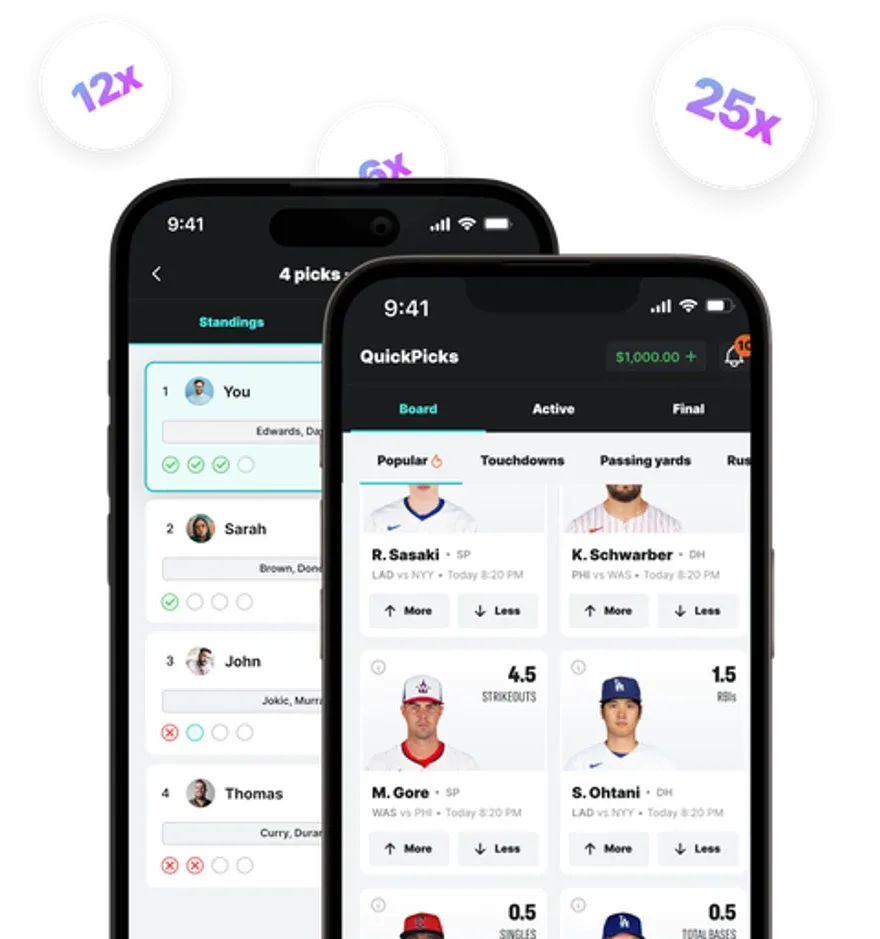
You've got two good options on Splash. Draft a lineup in Tiers, or call More or Less on a few stat lines in QuickPicks, Splash's player pick em format.
They look alike from a distance. Both are about players, not teams, and both are settled by tonight's box scores. Up close, they ask very different things of you. Here's how each works and which one fits the way you watch.
Quick verdict on NBA tiers vs pick em
Tiers for your group, pick em for speed
Our pick: NBA TIERS
Tiers fits most groups
Tiers is the better NBA fantasy contest for a group of friends: one lineup, one leaderboard, and room to run it for a night, a week or the whole season. QuickPicks wins when you have five minutes and want a quick entry.
Scored 0 to 10 on each criterion, by the Splash editorial team
| Criterion | NBA Tiers | NBA pick em (QuickPicks)Our pick |
|---|---|---|
| Built for your own group | 9/10 ✓ | 5/10 |
| Uses your full NBA knowledge | 9/10 ✓ | 7/10 |
| Season-long option | 9/10 ✓ | 3/10 |
| Time per entry | 6/10 | 9/10 ✓ |
| Protection when a player sits | 4/10 | 8/10 ✓ |
| Total | 37/50 | 32/50 |
If you run a group chat full of fantasy basketball diehards, start with Tiers. Everyone drafts from the same board, the leaderboard updates live, and the commissioner can stretch the contest across multiple slates.
If you just want a quick sweat on tonight's games, QuickPicks is faster. Two to five calls, players from at least two teams, done before tip.
Here's the belief to drop: that a shorter entry is the safer one. It isn't. Fewer picks means each miss carries more weight, while a six-player lineup can survive one quiet night.
Most NBA fans end up playing both. They scratch different itches.
How NBA tiers contests work
Six tiers, six picks, no positions
Each slate, Splash splits the available players into tiers based on their projected fantasy points. NBA tiers contests use six of them. You pick one player from each tier, and the lineup with the most fantasy points wins.
That's the whole Splash Tiers game. No salary cap to juggle, no positional slots to fill.
Tiers can run on a single slate, across several weeks or for a full season. Season-long contests can add a Player Use Limit, so you can't ride the same superstar every night, and Drop Your Worst, which tosses your lowest scorer from that slate.
Picking one player per tier
Tier 1 is easy, Tier 6 wins it
Everybody's Tier 1 pick looks about the same. The top of the board is where the crowd agrees.
The lower tiers are where contests get decided. A bench guard who gets starter minutes because of a late scratch can outscore half the players above him.
Think about the field, too. In a big public contest, most entries will share the same Tier 1 star, so a different pick in a middle tier is how you gain ground. In a ten-person friends contest, taking the obvious name is usually fine.
Two rules to know. Your lineup can't be all one team, so at least one player has to come from a different roster. And there are no positional requirements, so six forwards is a legal lineup if you believe in it.
For the full walkthrough, Splash's introducing NBA tiers guide covers the format from the first pick to the final leaderboard.
NBA fantasy points & scoring
One number for the whole stat line
NBA fantasy points turn a player's real stat line into a single number. Splash uses the same scoring for each stat across every Tiers contest, and the exact values are listed in your contest's Rules section. You can't customize them, which keeps every leaderboard on the same math.
Fantasy points per game is the number to study, not points alone. Luka Dončić led the league at 33.5 points per game in 2025-26, per Basketball-Reference, but scoring is only part of what fills a fantasy line.
One more thing. Players who are inactive or injured don't score. If your pick sits, that tier gives you zero.
How NBA pick em contests work
More or Less, nothing else
A quick note on names first. The Splash Pick'Em game is the pick-every-matchup team format, and it runs on football slates. For basketball, Splash's NBA pick em play is QuickPicks, which Splash calls its player pick em format.
Here's how it works. You pick a stat line for each player, like points or rebounds, and call More or Less. Every pick card shows its implied probability, so you know what you're picking.
- Each entry has 2 to 5 picks.
- Your players have to come from at least two different teams.
- Each player can appear only once per entry.
A correct call earns 1 point, a tie earns half a point, and a miss earns zero. The highest score in your contest takes first place.
Your pick count also sets the size of your contest. A 2-pick entry plays in a contest of up to 4 entries, and a 5-pick entry plays in one of up to 32. More picks, bigger field.
Building an NBA pick em today takes about as long as reading the injury report. That's the appeal.
NBA pick em predictions by game
Read the game before the player
Good NBA pick em predictions start with the matchup, not the name on the card. A stat line is a guess about minutes, and minutes depend on the game.
- Blowout risk: a lopsided game can bench starters in the fourth quarter. That hurts a More.
- Back-to-backs: tired legs and rest days for veterans. Check status close to tip.
- Pace: faster games create more possessions, and more possessions create more stats. The average team scored 115.6 points a game in 2025-26, so a matchup projected well above that is a good place to look for a More.
- Late scratches: when a starter sits, his minutes go somewhere. The teammate who absorbs them is often the best More on the board.
If a player you picked starts the game, he's scored as usual even if he gets hurt early. If he doesn't play at all, the pick earns half a point.
Effort, risk & payouts compared
Same night, different kinds of sweat
NBA Tiers vs QuickPicks on Splash
| NBA Tiers | QuickPicks (NBA pick em)Our pick | |
|---|---|---|
| What you pick | One player from each of six tiers | More or Less on player stat lines |
| Picks per entry | One per tier | 2 to 5 |
| How you score | Fantasy points from real stats | 1 point per correct call, half a point for a tie |
| Roster rule | Not every player from the same team | Players from at least two teams, each player once |
| If a player sits | Inactive or injured players don't score | A DNP earns half a point |
| Contest length | One slate, multiple weeks or a season | One slate |
| Who you play | Your group or a public contest | Other players in a contest sized by your pick count |
| Winners paid | Automatically when the contest ends | Automatically; ties for first split evenly |
Effort. Tiers asks for more homework. You're comparing six groups of players, and the best NBA fantasy projections only get you to the start line, since everyone sees the same tiers. QuickPicks asks for two to five sharp calls.
Risk. In Tiers, one player sitting costs you a whole tier. In QuickPicks, a DNP still earns half a point, and a player who starts and leaves hurt is scored on what he did. But QuickPicks has fewer picks, so each miss weighs more.
Payouts. Both are peer-to-peer contests, so you're playing other fans, not the house. In QuickPicks, contest size depends on how many picks you make, and if a contest runs short of the maximum entries, the guaranteed prize stays the same. In Tiers, prizes follow the contest you join. Current prize pools and offers show in the app.
The honest summary: Tiers spreads your risk across six players and rewards depth of knowledge. QuickPicks concentrates it into a few calls and rewards a sharp read on tonight's matchups. Neither one has you playing against a house that sets the line.
Before you set either lineup, check current NBA season stats for minutes and per-game trends. For lineup-building ideas on the Tiers side, read our secrets to succeed in tiers pools.
Which nightly NBA fantasy contest fits you
Pick the format that fits your night
Start with how you watch. Some fans have the whole slate on three screens. Others catch the late game from the couch.
Play Tiers if:
- You want to compete against the same group all season.
- You like building a lineup more than making single calls.
- You follow the bench rotation, not just the stars.
Play QuickPicks if:
- You have a strong read on two or three players tonight.
- You want an entry in under five minutes.
- You'd rather sweat a few stat lines than a full lineup.
The social side matters more than people admit. Tiers contests have in-contest chat, so the razzing happens next to the leaderboard instead of buried in a group text. QuickPicks is a quieter, solo sweat.
Your NBA fantasy picks tonight don't have to be either-or. Plenty of players run a Tiers lineup with their group and a QuickPicks entry on the side.
If you came up through salary-cap daily fantasy basketball, Tiers will feel familiar without the spreadsheet. If you came from season-long leagues, QuickPicks is the fastest way to get a nightly sweat without managing a roster.
How to play NBA fantasy contests on Splash
Six steps to your first entry
Here's how to play NBA fantasy on Splash, from download to payout.
- Get the app or go to the site. Download Splash Sports on iOS or Android, or sign up on the web.
- Verify your location. State law requires it before you deposit or join a contest. Splash runs in most of the US and Canada, and minimum ages and format availability vary by state.
- Pick your format. Head to the QuickPicks board for player calls or the Tiers lobby for a lineup.
- Make your picks before the deadline. Turn on app notifications so the pick reminders find you.
- Track it live. Leaderboards and pick reports update as the games play out.
- Get paid. Winners are paid automatically when contests end, and funds are available to withdraw right away.
Want your own group on one board? Start a Tiers contest as a commissioner and invite your friends. Splash collects the entries and pays out the winners.
Check the injury report. Set your lineup. Watch the box score.
Frequently asked questions
Quick answers before tip-off
QuickPicks is the easier start. You make two to five More or Less calls, and a player who doesn't play still earns half a point. Tiers asks for a full six-player lineup, but the rules are just as simple: one player per tier, no positions. Try QuickPicks first, then join a Tiers contest with friends.
Each player's real stat line converts to fantasy points using one fixed scoring table, and Splash uses the same values in every Tiers contest. You'll find the exact points per stat in your contest's Rules section. Players who are inactive or injured during the slate don't score.
Yes. Tiers and QuickPicks are separate contests, and each entry follows its own rules and deadline. Plenty of players draft a Tiers lineup with their group and add a QuickPicks entry on the side. Just remember QuickPicks needs players from at least two teams.
The team-by-team Pick'em game runs on football slates. For the NBA, Splash's pick em option is QuickPicks, where you call More or Less on player stat lines. If you want a season-long NBA contest with your own group, Tiers is the better fit.
As long as the player starts the game, he's scored as usual, even if he only plays a few minutes. A player who doesn't play at all earns half a point. If a DNP leaves your active picks all on one team, the entry is voided and refunded.
Play on the go
Take Splash Sports with you
Make your picks, track live scoring, and cash out instantly from anywhere. The Splash app puts every contest (Survivor, QuickPicks, Pick'Em and brackets) in your pocket, free on iOS and Android.