



If you follow NBA injury reports or track player availability before games, you’ve likely seen GTD next to a player’s name. It’s a common designation that can impact lineups, rotations, and fantasy player stat decisions across basketball and other sports.
This article explains the meaning of GTD, how it’s used in the NBA, and why it matters for fantasy sports fans who enjoy making player stat selections.
GTD Meaning: What Does GTD Stand For?
GTD stands for Game-Time Decision.
When a player is labeled GTD, it means their availability will be determined closer to the start of the game. Teams want to evaluate how the player feels during warmups or pregame testing before making a final call. In simple terms:
- GTD indicates uncertainty
- The player may or may not play
- Official confirmation usually comes shortly before tipoff
What Does GTD Mean in the NBA?
In the NBA, GTD commonly appears under the Questionable injury designation. In most apps and injury reports, these two labels are treated the same way. A GTD designation usually suggests:
- Minor injuries, soreness, or load management
- Teams are being cautious during back-to-backs
- Final status depends on pregame movement and comfort
Because NBA roles are highly usage-dependent, a single GTD can influence:
- Minutes distribution
- Offensive opportunities for teammates
- Overall game flow
That’s why fantasy players monitor GTD updates closely leading up to game time.
Meaning of GTD in Basketball
While GTD is most often discussed in the NBA, the term applies across basketball:
- College basketball injury reports
- International leagues using English-language status updates
- Playoffs and tournaments, where teams delay disclosures
No matter the league, the meaning remains consistent: the player’s status will be decided at game time.
Why GTD Matters for Fantasy Player Stat Picks
GTD designations are especially important for fantasy contests that revolve around player stat selections.
A GTD player can affect:
- Whether you include that player in your lineup
- Which teammates may see expanded roles
- How you interpret late-breaking lineup news
On the Splash Sports app, GTD players typically appear as Questionable, helping fantasy players quickly identify uncertainty before making their selections.
Example
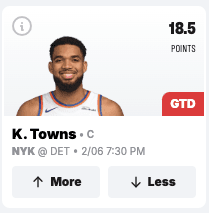
Imagine Karl-Anthony Towns is listed as GTD for an upcoming Knicks vs. Pistons matchup, with a Points line of 18.5 displayed in the app. The GTD tag signals that Towns’ availability has not yet been confirmed and will be decided closer to tipoff. In this situation, fantasy players know:
- Towns may play his normal role, reduced minutes, or not appear at all
- Final confirmation will likely come after warmups
- If Towns is ruled out, other Knicks players could see increased scoring opportunities
Seeing the GTD label helps fantasy participants decide whether to include Towns’ points stat or shift focus to teammates whose roles could expand depending on the final lineup. Monitoring updates leading up to game time is key when a GTD designation is involved.
How GTD Fits Into Fantasy Contests Like QuickPicks
Understanding GTD is an important part of playing fantasy contests that rely on player stat predictions. In QuickPicks, fans use NBA knowledge to:
- Read injury situations accurately
- Anticipate role changes if a GTD player sits
- Adjust selections based on confirmed lineups
Fantasy players who follow availability updates closely often gain an edge when late news changes how minutes and opportunities are distributed. If you’re new to the format, this guide on how to play QuickPicks walks through the basics.
Other Injury Designations vs GTD
Here’s how GTD compares to other common availability labels:
- Probable: Expected to play
- Questionable / GTD: True game-time call
- Doubtful: Unlikely to play
- Out: Will not play
Among these, GTD creates the most uncertainty, making it one of the most important designations to monitor for fantasy contests.
Where Fantasy Managers Can Find Reliable GTD Updates
Fantasy managers need a clear process for tracking GTD status, because the most useful updates usually arrive late and change quickly. The best places to check are the official injury report, team announcements, and trusted fantasy news sources that update player availability close to tipoff. Team reports are helpful because they show the current status label, while beat writer updates and pregame notes often explain whether a player is warming up, ruled in, or expected to sit.
Fantasy managers should also monitor starting lineup announcements, since those often confirm the final decision minutes before game time. In practice, the goal is not just to learn what GTD means, but to know where the most current status information appears and how close to tipoff it is likely to change. Many fantasy platforms also surface player news within individual profiles, making it easier to check availability without having to search multiple sites.
Push notifications can be especially useful because they alert managers the moment a player’s status changes from questionable to active or out. Social updates from team reporters can add important context, too, especially when a player is listed as a GTD for rest, illness, or a minor injury. For fantasy managers, the key is to build a habit of checking several sources in the final hour before lineup lock so they can react fast if a player is downgraded or unexpectedly cleared. This is important in leagues that allow late swaps, because a last-minute update can determine whether a manager keeps a player active or switches to a safer option. A strong GTD-check routine also helps managers avoid relying on stale information from earlier in the day. Since player availability can shift after warmups, the most useful updates are the ones that reflect the latest pregame testing and official team decisions.
Manage GTD players with a “start, monitor, pivot” approach
The best way to handle GTD players in fantasy sports is to treat them as a decision-making process rather than a label. Start by asking whether the player is truly worth the risk. A GTD tag on a star with strong production can still be playable, but only if your roster can absorb a last-minute change. If the player is replaceable, the safer move is often to use a healthy option with a stable role, especially in formats where one missed game can erase a big chunk of value. Next, monitor how late the decision is likely to come. Some GTD situations are resolved quickly, while others stay uncertain until warmups or closer to lineup lock. That timing should shape your plan. If your league allows late swaps, keep a bench player or streaming option ready so you can pivot the moment news breaks.
If your league does not allow late changes, make your final choice based on downside protection rather than hope. It also helps to separate the player’s availability from the player’s effectiveness. A GTD player may suit up but still carry limited minutes, reduced usage, or role restrictions, which means a “playing” status does not always equal full fantasy value.
Managers should think about the floor and the ceiling together: if the floor is too low, the upside may not justify the risk. Another useful habit is to compare the GTD player with the alternatives already on your roster. If the backup is in a strong matchup or has a secure workload, the safer player may be the better fantasy play even if the GTD player has more name value.
Depth matters here because teams with versatile bench pieces can absorb uncertainty more easily than thin rosters. It is also smart to avoid making decisions too early in the day. GTD tags can change after warmups, so the most reliable information usually comes close to tipoff. Build a routine of checking the latest status before your lineup locks, and do not assume earlier reports will hold. Managing GTD players well means preparing for multiple outcomes, protecting your lineup from zeros, and choosing the option that gives you the best balance of upside, safety, and timing. That approach helps fantasy managers stay flexible and make smarter decisions when uncertainty is highest.
So, what does GTD mean? It stands for Game-Time Decision, and in basketball, it signals that a player’s availability won’t be confirmed until shortly before the game begins. For NBA fans and fantasy players alike, understanding GTD helps you stay informed, react to late updates, and make smarter player stat selections.