


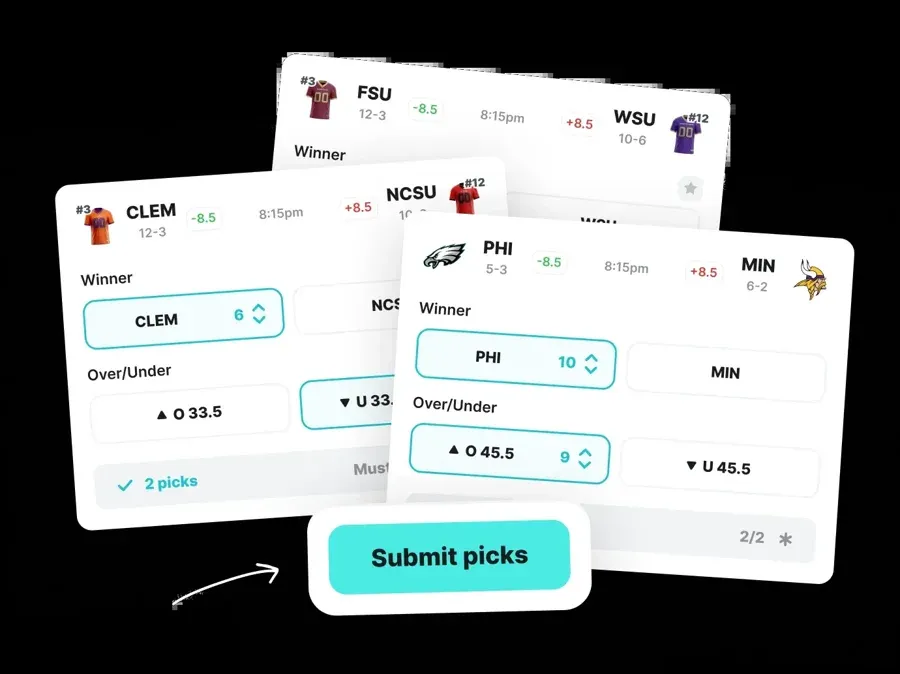
Tuesday morning, the group chat lights up. Somebody wants a weekly NFL contest this season, and everybody's in.
Then the real question lands. Does every game count the same, or do you rank them?
That's the whole fight between a straight pick em and a confidence pool. Same slate, same Sundays, very different contests. One rewards the person who gets the most winners right. The other rewards the person who knows which winners they're sure about.
Here's how each one works, where each one wins, and how to pick the right one for your group.
Quick verdict on pick em vs confidence pool
Most groups should start with pick em
Our pick: NFL PICK EM
Pick em fits most groups
A pick em NFL contest is faster to fill out, easier to explain and harder to wreck with one bad Sunday. A confidence pool wins on depth, and it's the better call for a group that watches every game.
Scored 0 to 10 on each criterion, by the Splash editorial team
| Criterion | NFL pick em | Confidence pool |
|---|---|---|
| Easy to learn | 10/10 ✓ | 6/10 |
| Time per week | 9/10 ✓ | 6/10 |
| Forgiveness for one bad pick | 8/10 ✓ | 5/10 |
| Fits a big casual group | 9/10 ✓ | 6/10 |
| Rewards real analysis | 6/10 | 9/10 ✓ |
| Fewer ties | 5/10 | 8/10 ✓ |
| Total | 47/60 | 40/60 |
If your group has twelve people and four of them only watch the late game, run pick em. Everyone can fill out the sheet in a few minutes, and nobody's season dies in Week 3.
If your group argues about injury reports on Wednesday, run a confidence pool. Ranking every pick adds a layer of decisions, and that layer is where the sharp players pull away.
You don't have to guess wrong for long, either. On Splash, both are the same Pick'em contest with a different scoring setting.
How an NFL weekly pick em works
One game, one point, every week
An NFL weekly pick em is the contest your office used to run on a printed sheet. You pick a winner for every game on the slate. Each correct pick is worth one point. Most points wins the week, and the weeks stack into a season title.
The regular season runs 272 games across 18 weeks, and every team gets a bye somewhere between Week 5 and Week 14. So a full week is 16 games, and bye weeks run shorter. Keep the official NFL schedule open when you set up the season so nobody's surprised by a 13-game week.
Two settings shape every nfl pick em.
- Straight up or against the spread. Straight up only cares who wins. Against the spread means your team has to cover a point spread, which turns easy favorites into real decisions.
- The tiebreaker. Most groups use a guess at the Monday night total. Closest without going over takes it.
Here's the part people miss. Pick em looks too simple to separate anybody.
It isn't. Over 18 weeks, the player who goes 11-5 every single week beats the player who chases upsets and goes 14-2 once. Consistency is the whole game.
How an NFL confidence pool works
Same picks, very different stakes
A confidence pool starts the same way. You pick a winner for every game. Then you rank those picks from most sure to least sure.
In a full 16-game week, your strongest pick is worth 16 points, the next is worth 15, and so on down to 1. Each number gets used exactly once. Hit a pick and you score its number. Miss and you score zero for that game.
That one extra step changes what NFL confidence picks really are. You're not just calling winners. You're putting a number on how sure you are, and the scoreboard holds you to it.
Assigning confidence points
Your top three numbers carry the week
Start at the top. The 16, 15 and 14 belong to the games you'd be stunned to lose. Those three picks alone are worth 45 points, a third of the 136 available in a full week.
Then work from the bottom. True coin flips go in the 1 to 3 range, where a miss barely dents you.
The middle is where confidence pool picks get decided. Teams you lean on but don't love belong somewhere in the 6 to 11 range. For a fuller method, here's how to rank your picks wisely before the Sunday rush.
NFL confidence picks by matchup
Sort the slate before you rank it
Ranking 16 games in one pass is how people end up with a 14 on a divisional rivalry. Sort first, then number.
- Big home favorites: the top of your board. These are your 14 to 16 slots.
- Big road favorites: one notch lower. Travel adds a variable you don't need in your top three.
- Divisional games: these teams see each other twice a year. Keep them in the middle unless the gap in talent is obvious.
- Short-week games: Thursday kickoffs bring tired legs and thin prep. Shade them down a few spots.
- Coin flips: the bottom three numbers, no matter how strong your gut feels.
Check the injury report one last time before kickoff. A quarterback ruled out on Friday should move your ranking, not just your pick.
Scoring compared
Every game equal, or some games huge
The difference fits in one line. In pick em, every game counts the same. In an NFL confidence pool, the games you rank highest count the most.
NFL pick em vs confidence pool, head to head
| NFL pick em | Confidence pool | |
|---|---|---|
| Picks per week | Every game, or a set the commissioner picks | Every game, ranked by confidence |
| Points per correct pick | 1 point | The pick's rank, 1 to 16 in a full week |
| Best possible week (16 games) | 16 points | 136 points |
| Cost of one wrong pick | 1 point | Up to 16 points |
| Time to fill out | A few minutes | Longer, since every game gets a number |
| Straight up or ATS | Either | Either |
| Best for | Big, casual groups | Groups that watch every game |
Both formats work with NFL straight up picks or against the spread. Straight up pairs naturally with confidence ranking, because you're rating how sure you are that a team wins, not whether it covers.
Picture two players who both go 12-4. In pick em, they tie at 12. In a confidence pool, the player whose four misses sat in the 1 to 4 slots scores 126. The player who missed on the 13 through 16 scores 78. Same record, 48 points apart.
Scoring is also why NFL confidence pool picks swing harder week to week. One upset in your 16 slot costs more than missing your four lowest-ranked games combined.
Where pick em wins
Fast, forgiving & easy to explain
- Anyone can fill out a full sheet in a few minutes, even on game day.
- A single upset costs one point, so one bad Sunday rarely ends a season.
- New players understand the rules in one sentence, which keeps big groups big.
- It's the most familiar football contest there is, so recruiting the group chat is easy.
Where a confidence pool wins
Depth for the group that watches everything
- It rewards knowing which games are safe and which are coin flips, not just picking winners.
- Scores spread out across a wider range, so weekly ties come up less often.
- A player who trails can climb fast with a strong week at the top of the board.
- Every game on the slate matters to your score, so the late window stays tense.
Which format fits your group
Match the format to the room
Count how many people in your group actually watch on Sunday. That number decides it more than anything else.
Run pick em if:
- Your group is big, mixed or new to weekly contests.
- Half the group makes picks on their phone ten minutes before kickoff.
- You want people still playing in December.
Run a confidence pool if:
- Your group already tracks spreads, injuries and short weeks.
- Last season's pick em ended in a pile of ties.
- You want the most prepared player to win, not just the luckiest one.
There's a middle ground, too. Keep Standard scoring but weight primetime and divisional games heavier, or let players mark a Best Pick for bonus points. The group gets a taste of ranking without having to number all 16 games every week.
Field size changes your confidence pool strategy, too. In a small office group, the safe consensus ranking usually holds up. In a large field, you'll need a few less popular picks to stand out from everyone who copied the same favorites.
Still deciding between weekly formats and elimination formats? Read our breakdown of confidence pool vs survivor pool before you send the invite.
Running either pool on Splash
Same contest, your scoring call
On Splash, you don't pick a product. You pick a setting. Every NFL pick em pool starts as a Pick'em contest, and scoring comes down to Standard or Confidence.
Choose carefully. The scoring format and the league are locked in when you create the contest. Almost everything else can change mid-season and re-grades automatically.
- Standard scores a point per correct pick. You can add Best Pick, where players mark one or more picks for bonus points.
- Confidence has players rank every pick. A correct #16 earns 16 points, a correct #1 earns 1.
- Straight up or against the spread, with spreads from Splash or set by you, game by game.
- Forgiveness settings like Drop Worst Week and Auto Picks, so one missed deadline doesn't end anyone's season.
- Point values per game from 1 to 20, weekly multipliers and Must Picks for the rivalry game.
Here's the setting-by-setting guide to build a pick em contest that fits your league.
Big groups can add Segments, standalone leaderboards for a stretch of weeks like a first half or the playoffs. When the season leader pulls away in November, everyone else still has a race to win. Groups split the standings by department or family on top of the individual leaderboard.
The money side is handled too. Splash collects entries, runs live scoring and pays winners automatically when the contest ends. No chasing Venmo requests in October.
Not running your own pick em pool this year? Join a public contest from the Splash Pick'Em game page and play against other fans, not the house. Splash runs in most of the US and Canada, and eligibility varies by state.
Pick the scoring. Send the invite. Let Sunday sort it out.
Frequently asked questions
Quick answers before kickoff
Yes, a little. You make the same picks, then rank every one of them, so each week takes longer and a wrong pick near the top costs more. The upside is that knowledge counts for more. If your group watches a lot of football, the extra work is the fun part.
They do, and many groups prefer it. Straight up means a pick only has to win, so your confidence number reflects how sure you are about the winner. Against the spread works too, but ranking how sure you are that a team covers is a harder call.
Sort the slate before you number it. Put your safest home favorites at the top, true coin flips at the bottom, and everything else in the middle. Don't stack your top numbers on divisional games or short weeks. Check injuries one last time before kickoff, then leave it alone.
No. On Splash, the Standard or Confidence format is locked in when you create the contest, along with the league. Most other settings, including straight up or against the spread, weighted weeks and picksheet rules, can be changed after the season starts and re-grade automatically.
By default, ties go to the player closest to the Monday night total without going over, then head-to-head, then most correct picks on the week. The commissioner can change the order in the contest settings, so check your contest's Rules before the season starts.
Play on the go
Take Splash Sports with you
Make your picks, track live scoring, and cash out instantly from anywhere. The Splash app puts every contest (Survivor, QuickPicks, Pick'Em and brackets) in your pocket, free on iOS and Android.


