


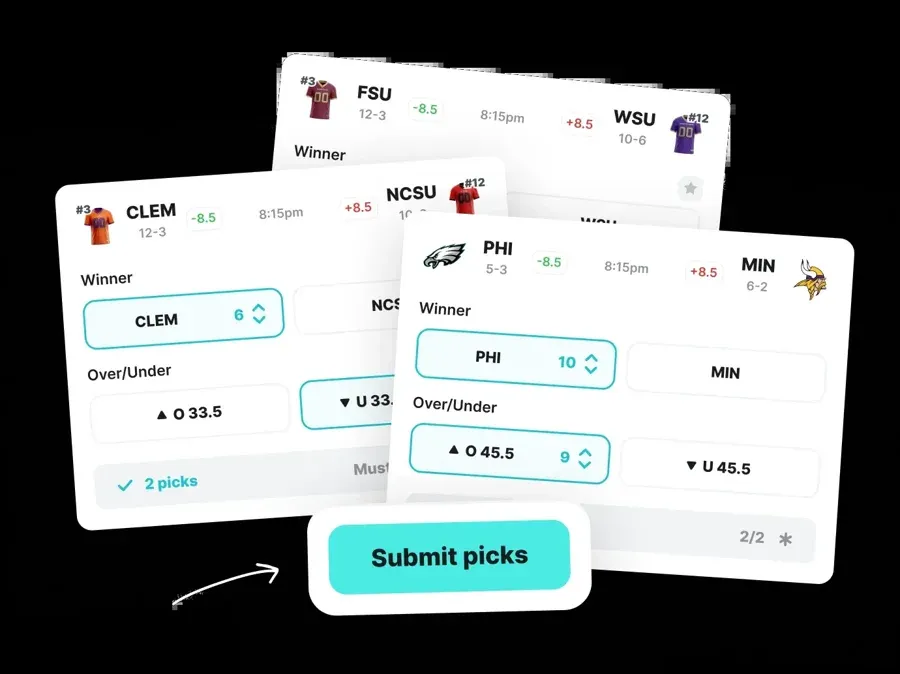
It's Sunday, 11:30 a.m. Your pick sheet has been done since Thursday. Then the group chat lights up: the starting quarterback for the team you took against the spread just landed on the inactive list.
Nobody broke a rule. The news followed the same path it follows every week, and your sheet just locked before the last stop.
This guide maps that path, from the first practice report to the final inactive list, and shows which news should change a pick and which news you can ignore.
What the NFL injury report tells you
Two reports, one question: who plays
Key takeaways
- The NFL injury report is two documents: a practice report and a game status report.
- Practice labels are Did Not Participate, Limited Participation and Full Participation.
- Game statuses are Out, Doubtful and Questionable. There is no Probable anymore.
- Inactive lists are due 90 minutes before kickoff, and that's when most game-day questions get settled.
- On Splash Pick'Em, a by-game deadline keeps each pick open until that game kicks off.
The nfl injury report is the league's required disclosure of who is hurt and how much they're practicing. For an NFL pickem player, it's the closest thing to a scouting report you get for free.
It won't tell you who wins. It tells you which version of a team shows up, and in pick'em that difference decides the close calls. Pair it with the rest of your homework and you're making smart NFL pickem selections instead of guessing from last week's box score.
Practice participation
Reps tell you more than quotes
Every injured player on the practice report gets one of three labels. Under the league's policy, Did Not Participate means what it says. Limited Participation means less than 100% of the player's normal repetitions. Full Participation means 100% of them.
The trend matters more than any single day. A player who goes DNP, then limited, then full is trending toward the game. A player who goes limited, then DNP late in the week is the one to worry about.
Game status designations
Three words that settle most weeks
The game status report uses three designations. The league defined them in 2016, and they're still the only three on NFL.com's weekly report:
- Out: the player will not play.
- Doubtful: it is unlikely the player will participate.
- Questionable: it is uncertain whether the player will play.
The league dropped Probable that year because roughly 95% of players listed as probable in prior seasons played anyway. Under the same 2016 rules, a player who is certain to play isn't given a game status at all, even if he showed up on the practice report. If that player is then deactivated, the team has to explain it to the league and can face discipline.
So once the statuses are out, a blank one is quietly good news. Questionable is where the real uncertainty lives.
How injury news flows, step by step
Same path every week, three stops
Injury information reaches you in three waves for a standard Sunday game. Know the timing and you'll know which picks to make early and which to hold until NFL inactives come out.
Step 1
Wednesday to Friday practice reports
Three days of clues, one trend
For a Sunday game, teams file a practice report on Wednesday, Thursday and Friday, by 4 p.m. ET or as soon as possible after practice ends. The calendar shifts for other game days: Monday through Wednesday for a Thursday game, Tuesday through Thursday for a Saturday game, and Thursday through Saturday for a Monday game.
Wednesday's report is the hardest to read. A DNP can be a veteran's rest day or a precaution, not a setback. Thursday and Friday show which way the week is trending.
Step 2
Friday game statuses
The week's first real answer
The game status report comes out with the final practice report of the week. That's Friday for Sunday games, Wednesday for Thursday games and Saturday for Monday games.
This is the first time a team has to say Out, Doubtful or Questionable instead of just listing practice reps. For a pick'em player, Friday is when most of a sheet can be filled in. Out means the player will not play. Doubtful means unlikely, by the league's own definition. The Questionables are what you carry into the weekend.
Step 3
NFL inactives ninety minutes before kickoff
The last word before the first snap
Every team submits its inactive list 90 minutes before kickoff. That's the NFL inactives 90 minutes before kickoff rule in plain terms, and it's the moment game-time questions get answered.
If you're checking nfl inactives today for a 1 p.m. ET Sunday window, the lists for those games arrive around 11:30 a.m. ET. Late-afternoon and night games follow the same 90-minute clock. Inactives are a team's game-day roster decisions, so expect healthy scratches mixed in with the injured players.
Tip
Set a reminder for 90 minutes before each kickoff window you have picks in. It takes two minutes to scan the inactive lists and it beats finding out from the group chat.
Reading the NFL injury report today
Where to look & what to skip
The cleanest place to read the nfl injury report today is the NFL.com injuries page. It lists every team in a game that week, and for each player shows the position, the injury, the practice status and the game status. A week selector lets you check earlier reports too.
Here's a fast way to read the latest NFL injury report for a pick'em sheet:
- Start with game status, not practice status. Out and Doubtful players are the first filter.
- Check the position. A starting quarterback on the list matters more than a backup at almost any other spot.
- Look for clusters. Two starting offensive linemen or two corners on one team can matter as much as one star.
- Read both sides of the game. An injury report only makes sense next to the opponent's.
Blank cells need context. Early in the week, nobody has a game status yet. Once the final practice report of the week is in, a player with practice reps and no game status was not given a designation, which under the 2016 rules means the team expects him to play.
Game time decision players
Questionable on Friday, mystery on Sunday
A game time decision is a player whose status won't be settled until the day of the game, often after a pregame workout. It isn't an official designation. On the report, these players usually carry a Questionable tag.
The rules give teams room here. Asked about it in 2024, the league told Pro Football Talk that if a club works out a player at the stadium on game day and decides he won't play, it doesn't have to update the game status report. The team can wait and put him on the inactive list at the 90-minute deadline.
Translation: a Questionable player can be ruled out at the stadium hours before kickoff, and you won't see it until the inactive list posts.
So how do you pick around one? Ask how much the game changes without that player. If the answer is "not much," make the pick and move on. If the player is the starting quarterback, the honest move is to hold the pick until inactives come out, if your contest's deadline lets you. Learning to analyze NFL matchups with and without a key player makes that call faster.
Heads up
A Questionable tag on Friday tells you a decision is pending. It does not tell you which way it's leaning. Read the practice trend before you guess.
When an injury should flip your pick
Most injury news shouldn't flip a pick
Our advice: most injury news shouldn't change your NFL pick em sheet. A team losing its third receiver is still the same team.
The news that should make you reconsider is narrower than you'd think:
- The starting quarterback. If you only check one name per team, make it this one.
- A cluster at one unit. Several offensive linemen or defensive backs out at once.
- A close spread. A pick you made at a coin flip can tip on a smaller injury than a pick you made with a big edge.
Most pick em NFL advice skips the format question, and it matters. On the Splash Pick'Em game, the commissioner picks the deadline: lock everything at the first kickoff, or lock game by game so each pick stays open until that game starts. In a by-game contest, you can wait for the inactive list on every game. In a first-kickoff contest that opens with a Thursday game, your Sunday picks lock before Friday's game statuses even exist.
Spread contests add one more wrinkle. Unless your commissioner enters their own numbers, Splash pulls a line for every game and locks it at your deadline, so the spread you pick against is the one in place when your sheet locks.
Treat any NFL pick em predictions you read on Wednesday as drafts. The picks that hold up are built from NFL team analysis first and injury news second.
Common mistakes to avoid
Easy ways to give away a week
- Panicking on Wednesday. A DNP on the first practice report can be a rest day or a precaution. Wait for the trend.
- Reading Questionable as Out. By the league's definition it means uncertain. Wait for the inactive list before you treat it as Out.
- Ignoring the other team. Your pick's opponent has an injury report too.
- Treating a by-game deadline like a Thursday deadline. If each game stays open until kickoff, use that window on your shakiest picks.
- Flipping a pick over a depth player. Backups get hurt every week. It rarely changes who wins.
- Forgetting the deadline. Splash sends reminders before the pick deadline, and auto-picks can fill missed games if your commissioner turns them on. Neither one reads the injury report for you.
Read Friday. Check inactives. Then make the pick.
For commissioners
If your group keeps arguing about late scratches, switch the contest to a by-game deadline. Each pick stays open until its own kickoff, and nobody has to call a Sunday morning audible on a Thursday sheet.
Frequently asked questions
Short answers for Sunday morning
Teams submit inactive lists 90 minutes before kickoff, for every game. For a 1 p.m. ET start, that's around 11:30 a.m. ET. Thursday, Monday and late-window games follow the same 90-minute clock, so inactives arrive in waves through a busy Sunday.
Start with the starting quarterbacks. If you check one name per team, make it that one. After that, look for clusters: several offensive linemen or defensive backs out on one team. A single injury at a deep position rarely deserves a flip. Close games are where smaller injuries can tip a pick.
For games with a Questionable starter, yes, if your deadline allows it. In a Splash Pick'Em contest with a by-game deadline, each pick stays open until that game kicks off. If everything locks at the first kickoff, decide using Friday's game statuses and the practice trend.
It means the player took part in practice but did less than 100% of their normal repetitions. Full participation means 100%. Read a limited tag next to the game status, not on its own: the status is the team's actual call for Sunday.
The league removed Probable in 2016 because about 95% of players listed that way in earlier seasons played. Under the 2016 rules, a player who is certain to play gets no game status, and a team that deactivates such a player must explain it to the league.
