


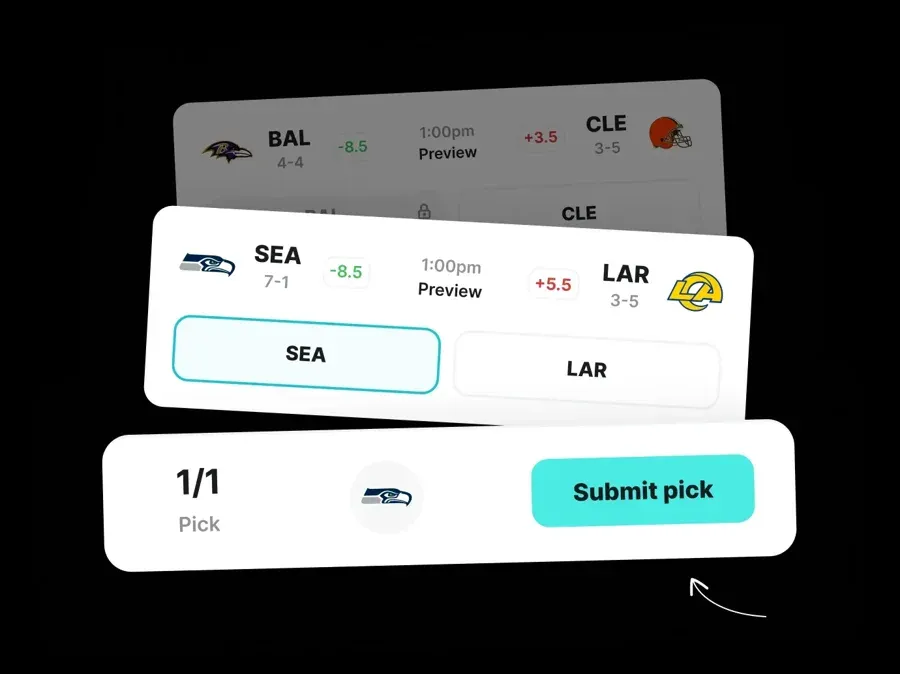
Week 11. Four entries left in the office pool, and all four are on the same big favorite. Either everybody advances, or the group chat lights up with one question.
Who gets the money?
That question deserves an answer before Week 1. We pulled every regular-season week of public survivor pick data from 2010 to 2025 and built a model of how pools of different sizes finish. The tie rates below are model estimates, kept apart from the real pick records and the published contest results. Here is what each one shows, and which rules settle a tie.
Key findings on ties & splits
Modeled small pools tie about 3 in 10
By the numbers
- 29.8% — of 10-entry pools end in a tie in our model, almost all of them in a wipeout week (Model estimate, not a count of real pools: each entry survives independently at that week's public survival rate. SurvivorGrid picks, 2010-2025)
- 72.2% — of 1,000-entry pools end with 2 or more entries tied in our model (Model estimate, not a count of real pools: each entry survives independently at that week's public survival rate. SurvivorGrid picks, 2010-2025)
- 20.2% — of weeks (56 of 277) where the most-picked public survivor team lost or tied (Observed: SurvivorGrid public pick data and results, 2010-2025 seasons)
- 33.4% — of regular-season games where the point-spread favorite lost outright (Observed: nflverse game data, 4,171 games, 2010-2025 seasons)
- 6 of 6 — Circa Survivor contests from 2020 to 2025 that ended with 2 or more winners sharing the prize (Observed: results reported by Covers and VSiN, 2020-2025 seasons)
Start with the model, and remember it is an estimate, not a count of real pools. In a survivor league nfl fans run for 10 to 50 people, it puts the chance of a tied finish at about 3 in 10. Most of those modeled ties come from a wipeout week, when all the remaining entries lose at once.
In an nfl survivor league with 500 or more entries, the modeled tie looks different. Two or more entries are still standing after the final regular-season week in 46.7% of modeled 500-entry pools and 66.3% of modeled 1,000-entry pools.
The inputs are records, not estimates. From 2010 to 2025, the average season had 5.9 weeks in which 30% or more of public survivor picks lost. Those mass eliminations are what drive the modeled small-pool ties.
Separately, Circa Survivor, a large contest that publishes its results, has ended with 2 to 35 winners sharing the prize in every season from 2020 to 2025.
Everyone plans for a last-man-standing finish. The model says to plan for the tie too.
How we built the sample
Sixteen seasons of public picks, one model
Nobody publishes how private office pools end. There is no national registry of who won the accounting department's survivor league. So we built the closest thing that can actually be measured, and we label which parts are records and which part is a model.
The records. SurvivorGrid publishes the weekly pick distribution of public survivor pools, along with each team's result. We pulled every regular-season week from 2010 to 2025, 277 weeks in all. For 2010 to 2024 we used SurvivorGrid's blended average, built from sites including Yahoo, ESPN, OfficeFootballPool and RunYourPool depending on the year. (Splash Sports owns OfficeFootballPool and RunYourPool.) SurvivorGrid shows no blended average for 2025, so we used the mean of its Yahoo, ESPN and USA Football Pools figures and left out its projections.
A week's elimination rate is the share of picks on teams that lost or tied. NFL ties count as losses, the default in many pools. Three games show no result on SurvivorGrid: the 2016 Seahawks-Cardinals tie and two games that weren't played in their scheduled week. Each held under 1% of that week's picks, and all three were scored as survivals.
The check. The weekly records line up with three published benchmarks for nfl survivor pools. Our 2020 cumulative survival rate ends at 2.2%, the same figure PoolGenius reported for 2020. Our 2015 rate after Week 5 is 4.28%, matching PoolGenius's 4.3%, and our 2024 rate after Week 5 is 1.43%, in line with Action Network's report that more than 98% of entrants were out by then. That checks the inputs. It can't test the pool model, because no one publishes how private pools end.
The model. Every tie rate in this post is a model estimate, built on four assumptions:
- Every entry picks like the public average, so each week it survives at that week's public survival rate.
- Entries win or lose independently of each other.
- Each entry has one life, with no buybacks, revivals, multi-pick weeks or holiday bonus picks.
- A pool ends when one entry is left (single winner), when all remaining entries lose in the same week (wipeout tie), or when two or more are alive after the final regular-season week (season-end tie).
The math is exact binomial probability, no random draws, run for each season and pool size, then averaged across the 16 seasons with equal weight.
The favorites. The upset figures are records from the nflverse games file: 4,171 regular-season games from 2010 to 2025 with a point-spread favorite. For team-by-team context, TeamRankings publishes NFL win trends data by situation, including as a favorite and as an underdog.
Limits
Real pools don't pick exactly like the public average, and friends often copy each other, which can make wipeout weeks more likely than the model shows. The model also ignores extra lives, buybacks, multi-pick weeks and holiday bonus picks. Treat every modeled number as a planning estimate, not a measured rate.
How often a survivor pool tie happens
Small pools crash, big pools crowd
An nfl survivor pool can end tied in two ways. A wipeout tie happens when every remaining entry loses in the same week. A season-end tie happens when two or more entries survive every week. Either way, the rules have to decide who gets paid, which is why NFL survivor pool tiebreakers matter more than most groups assume.
Pool size decides which kind of survivor pool tie you're likely to get.
Model estimate: share of pools that end in a tie, by number of entries
| Model estimate: share of pools that end in a tie, by number of entries | Value |
|---|---|
| 10 entries | 29.8% |
| 25 entries | 29.1% |
| 50 entries | 31.5% |
| 100 entries | 36.8% |
| 500 entries | 57.4% |
| 1,000 entries | 72.2% |
Source: Model estimate, not a count of real pools: each entry survives independently at that week's public survival rate. SurvivorGrid picks, 2010-2025
Small pools
The wipeout week is the real threat
In a 10-entry survivor pool, the model gives a single winner 70.2% of the time, a wipeout tie 29.6% of the time and a season-end tie 0.3% of the time. The modeled tie rate swings hard by season, from 15% in 2020 to 50% in 2024.
Why so swingy? A handful of real weeks do most of the damage. In Week 2 of 2015, 90.0% of public picks lost, led by the Saints at 45.3% of picks. In Week 10 of 2019, the Saints (46.8%) and Colts (33.5%) both lost, and 86.2% of picks went down with them. When four friends all ride the same favorite, one upset ends the pool for everyone.
Real small fields have ended that way too. The first Circa Grandissimo, a 69-entry contest, ended in 2025 when its last six entries all lost over Thanksgiving week and split the prize, according to VSiN.
Model estimate: how pools end, by size (average of 2010-2025 seasons)
| Entries | Single winner | Wipeout tie | Season-end tie |
|---|---|---|---|
| 10 | 70.2% | 29.6% | 0.3% |
| 25 | 70.9% | 27.7% | 1.5% |
| 50 | 68.5% | 26.8% | 4.7% |
| 100 | 63.2% | 24.6% | 12.2% |
| 500 | 42.6% | 10.7% | 46.7% |
| 1,000 | 27.8% | 5.8% | 66.3% |
Large pools
Big fields usually split at the finish
Add entries and, in the model, the wipeout risk fades, because it gets harder for every survivor to lose in the same week. The finish gets crowded instead. At 500 entries, a modeled season-end tie (46.7%) is more likely than a single winner (42.6%). At 1,000 entries, only 27.8% of modeled pools produce one winner.
For a real-world reference point, Circa Survivor, a $1,000-entry contest that began in 2020, has reported a shared finish in every season since. It's one contest with its own rules, so it isn't a test of the model.
Observed: Circa Survivor final results, 2020-2025 (as reported by Covers and VSiN)
| Season | Entries | Winners | How it ended |
|---|---|---|---|
| 2020 | Not reported in sources used | 35 | Split |
| 2021 | Not reported in sources used | 5 | Split |
| 2022 | Not reported in sources used | 2 | Split |
| 2023 | Not reported in sources used | 4 | Split $9,267,000, after a chop agreement |
| 2024 | 14,266 | 8 | Split, $1.78M each |
| 2025 | 18,718 | 5 | Split, $3,743,600 each |
Winner take all vs split the pot
Decide the payout before Week 1
A winner take all pool sounds clean until three people are tied in Week 18. Then it needs a tiebreaker, and a tiebreaker nobody agreed to in August is an argument in January.
Splitting is the common default. PoolGenius calls splitting the prize among the remaining entries the standard approach when everyone loses, and says survivors who make it through the season typically divide the prize equally. On Splash Survivor, ties can split, or the commissioner can set a single-winner tiebreaker.
Big contests add a third option, the deal. Circa's 2023 finalists had a chop agreement in place for the last couple of weeks, according to Covers, and in 2024 talk of the final 18 chopping never materialized. A split the pot rule written down in advance gets you most of that fairness without the side negotiations.
Some Splash formats can also pay out along the way. In-season payouts launched for Golf One & Done contests, and the knowledge base post on segmented payouts on Splash lists Winner Take All, Pay Top 3, Pay Top 5 and Pay Top 10 options for each segment.
Our take
Under 50 entries, split the pot and write down what happens in a wipeout week. Over 500, pick a tiebreaker or accept that the prize will probably be shared, which is what the model and the Circa results both point to.
NFL survivor league rules that prevent ties
Rules that settle it on one name
If your group wants one champion, the fix lives in your nfl survivor league rules, not in hoping the favorites cooperate. These are settings on the Splash Survivor game page, and what each one does to the tie math.
- Single-winner tiebreaker. Resolve a tie to one winner by weeks survived, a championship total or net margin.
- Auto-revival. Turn it on and, if every remaining entry loses in the same week, the whole field gets a life back and the contest keeps going. That turns a wipeout tie into another week of football.
- Extra lives. Give each entry 1 to 5 lives. A shared upset costs a life instead of ending the pool, which takes some of the sting out of a wipeout week.
- Multi-pick weeks. Require extra picks on chosen weeks, or let the contest auto-expand to multi-pick weeks once the field thins. Useful for big fields that keep surviving.
- Against the spread. Grading picks against a spread makes each week harder to survive, which can thin a crowded field.
The full menu, including team-use limits, is in our survivor contest rules guide.
Use the data to set your survivor pool rules
Match the rules to the size of the room
Good nfl survivor pool rules start with one number: how many entries you expect. The model points to three setups.
Under 50 entries. Your likely risk is a wipeout week, about 3 in 10 by the model. Decide in advance whether a wipeout splits the pot, triggers a revival or goes to a tiebreaker. One of those three is right. Arguing about it after Week 9 is wrong.
Around 100 entries. Both endings are live. The model puts a wipeout tie at 24.6% and a season-end tie at 12.2%. Pick a tiebreaker stack you can explain in two sentences.
500 or more. Expect company at the finish. If one winner matters to your group, add multi-pick weeks late in the season or a tiebreaker. If it doesn't, a clean split keeps everyone happy.
Whatever you choose, put it in writing before Week 1. Splash lets commissioners adjust survivor pool rules all season, but changing how a contest ends while five people are still alive is how commissioners lose friends.
The Splash Survivor game page lays out every setting, from lives to revivals to tiebreakers, and Splash handles deadlines, eliminations and payouts once you hit create. Contests are peer-to-peer, so you play against friends and other fans, not the house. Availability varies by location, so check where you can play first.
Pick your ending. Write it down. Let the favorites do the arguing.
Frequently asked questions
Straight answers on ties & splits
It depends on your rules. The standard approach, per PoolGenius, is that the entries eliminated that week become co-winners and split the prize. Some pools let everyone keep playing instead. On Splash Survivor, a commissioner can turn on auto-revival, which gives the whole field a life back so the contest keeps going. Without it, the contest's tie settings decide.
No public dataset counts tiebreaker rules across private pools, so nobody can tell you what most leagues do. PoolGenius describes an equal split as the typical outcome when several entries survive. On Splash Survivor, ties can split, or a commissioner can set a single-winner tiebreaker based on weeks survived, a championship total or net margin.
In a small pool, settle on a split or a revival, because roughly 3 in 10 modeled small pools end in a wipeout tie. In a big pool, playing on with multi-pick weeks or a tiebreaker makes sense if your group wants one champion, since modeled big fields often reach the last week crowded. Either way, decide before Week 1.
In the SurvivorGrid data, the most-picked team lost or tied in 56 of 277 regular-season weeks from 2010 to 2025, or 20.2%. It happened as few as once in a season (2010) and as often as seven times (2021). Across all games in that span, point-spread favorites lost outright 33.4% of the time.
PoolGenius estimates, from weekly survival rates over the last decade, that a 10-entry pool lasts until about Week 9, a 25-entry pool until about Week 12 and a 50-entry pool until about Week 14. Pools of 100 or more should expect to run near the end of the season, if not all 18 weeks.
