


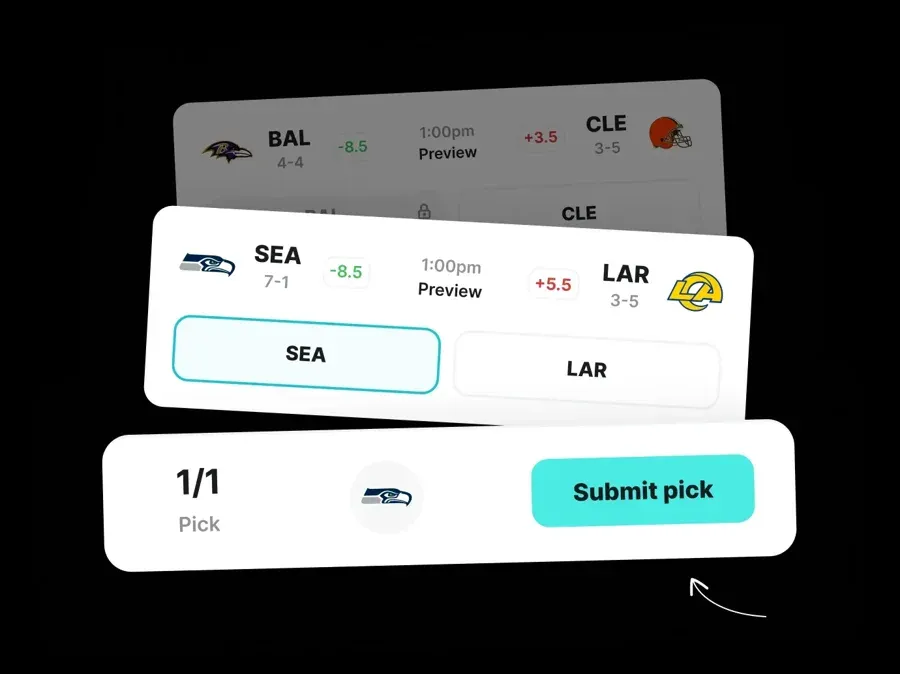
It's a November Sunday. The best team on the slate is a 10-point home favorite, the group chat is unanimous, and that team is already on your used list.
You burned it in Week 2 to get past a game you could have won with half the league.
Nobody plans to run out of good teams. They just take the best team every week until there isn't one left.
This guide fixes that. You'll build a grid, rate the schedule, circle the weeks each contender is a heavy favorite, decide who to save, and keep the whole plan honest every Tuesday.
Why plan your NFL survivor picks ahead
Every pick spends a team
What you need
- Your contest's rules — Lives, team-use limits, multi-pick weeks and tiebreakers all change the plan.
- The full 18-week schedule — Every opponent, home or away, and every bye.
- A grid — A spreadsheet or a sheet of paper. 32 rows, 18 columns.
- Twenty minutes a week — Tuesday works best, after Monday's game and before the new lines settle.
Here's the rule that makes survivor hard. In a standard NFL survivor pool you pick one team to win each week, and once you use a team, it's gone.
Splash's own Survivor page says it in five words: "Plan ahead when you can."
The 2026 regular season runs 18 weeks, and each team plays 17 games with one bye. You need a winner every week from a list of 32 teams that shrinks by one each time you survive.
Most people treat NFL survivor picks as 18 separate questions. They're one question asked 18 times, with fewer answers every week.
The good spots also don't arrive evenly. Some contenders have four or five soft matchups. Others have one. If you spend a five-spot team on a week where a one-spot team was available, you've wasted four chances you'll want back in December.
Byes squeeze it further. In 2026 the byes run from Week 5 through Week 14, with none in Weeks 1 to 4 or Week 12, and six teams are off in Week 11. Fewer teams on the slate means fewer safe homes for your pick.
A plan doesn't predict the season. It tells you what each pick costs before you make it.
Steps to map your season
Five steps from blank grid to plan
The first pass takes about an hour before Week 1. After that, the grid needs one short check-in a week. Here's the NFL survivor process from blank sheet to weekly routine.
Step 1
Build a survivor pool grid
32 rows, 18 columns, one sheet
Your survivor pool grid has a row for every team and a column for every week. Pull the matchups from the official NFL schedule and fill each cell with the opponent. Mark road games with an @ so you can see home field at a glance.
Black out each team's bye week. In 2026 that means nothing to shade until Week 5.
That's it. An NFL survivor grid is just the schedule turned sideways, so you read a team's whole season across one row instead of hunting through 18 weekly lists.
Step 2
Rate every team by NFL strength of schedule
Rank the schedule, not just the team
Give every team a simple tier: A for contenders, B for good, C for average, D for teams you want to pick against.
Then look at NFL strength of schedule, with one warning. It depends on how it's measured. A May 2026 ranking built on 2025 records had the Bears facing the hardest slate (.550 opponent win percentage) and the Browns the easiest (.429). Sports Illustrated's version, built on projected 2026 win totals, put the Cardinals hardest (.535) and the Lions easiest (.472).
Same season, two different lists. Use strength of schedule to spot soft stretches, then trust your own tier for each opponent in each cell.
Step 3
Mark the weeks each strong team is a big favorite
Circle the mismatches, then count them
Now go row by row through your A and B teams. Circle every week they play a C or D team, and double-circle the ones at home.
Point spreads for far-off weeks don't exist in the preseason, so your tiers stand in until lines post. Once they do, swap the circles for real numbers.
Count the circles in each row. A team with five circles is flexible. A team with one circle tells you exactly when to use it.
Then count down each column. The week with the fewest circles is your problem week. Solve it first.
Step 4
Save top teams for late weeks
Hold your aces for the thin weeks
Early weeks are crowded with good options. Late weeks aren't, because everyone still alive has already spent their easy teams.
So the rule is simple. If a strong team's circles are all early, use it early. If it has a circle in Week 13 or later, that circle is worth more than any of its September ones.
Watch the bye squeeze too. In 2026, Week 11 has six teams off, while Week 12 has every club playing during Thanksgiving week. Plan your path so a top team isn't the only option in a week it doesn't play.
Step 5
Update the plan every Tuesday
Results rewrite the grid every week
After Monday's game, cross off the team you used and re-tier anyone whose season changed. A starting quarterback injury can drop an A team to a C in one afternoon.
Then check what the field has left. In a Splash Survivor game, picks stay hidden until kickoff, and after that everyone can see who took whom. The weekly reports include pick distribution, availability charts and a survival grid, so you can see which teams your rivals have already burned.
Your survivor pool picks for the next two or three weeks should be firm. Everything past that stays in pencil.
Tip
Color-code the circles: one color for home games, another for road games. On the weeks you're torn, the home circle usually breaks the tie.
Balancing this week vs future value
Survive today without spending tomorrow
Every week comes down to three inputs. How likely is the team to win? How many entries will be on it? And how much is it worth to you later in the season?
The first one gets all the attention. The third one is where good NFL survivor pool strategy lives.
Picture two options. Team A is a heavy favorite and has four more circles on your grid. Team B is a slightly smaller favorite with no circles left after this week.
Take Team B. The extra safety you'd get from Team A is small, and the cost is a team you'd want back in December.
That's the flip most players miss. The safest pick this week isn't always the best pick for your season.
How to weigh two options in the same week (illustration)
| Team A | Team B | |
|---|---|---|
| This week | Heavy favorite | Solid favorite |
| Circles left on your grid | 4 | 0 |
| Share of the field likely on it | High | Moderate |
| Cost of using it now | A December option | Almost nothing |
| Usual call | Save | Use |
The rule of thumb runs both ways. When the gap in safety is small, protect the future. When the gap is big, say a near-certain win against a coin flip, take the safe team and live to see another week.
Field share matters too. If most of the pool is on one favorite and it loses, a huge chunk of entries go out at once. Being somewhere else that week can be worth a little extra risk. Splash's guide to survivor game theory breaks down why predictable picks leave you exposed.
Your NFL survivor pool picks should come out of that balance, not out of the spread alone.
Watch out
Saving teams only works if you're still alive to use them. A plan that takes a coin-flip in Week 3 to protect a Week 15 option has its priorities backward.
Survivor pool strategy for big & small pools
Your field size sets your risk
The size of your pool changes what a good plan looks like.
In a small pool, a dozen friends or an office group, the schedule is your main opponent. You only need to outlast a handful of people, so heavy favorites are fine even when everyone else takes them. Your grid's job is to make sure you still have favorites left in Week 14.
In a big pool with thousands of entries, surviving isn't enough. If you go out on the same team as everyone else, you were never going to win. Here your grid should flag the weeks where a less popular team is nearly as safe as the crowd's choice. Those are your separation weeks.
For a deeper look at pool size and pick popularity, read Splash's NFL survivor pool strategy guide.
Your contest's settings matter as much as its size. On Splash, a commissioner can give each entry 1 to 5 lives, let a team be used once, up to five times or unlimited times, add multi-pick weeks, or flip the whole contest to picking losers.
Each one rewrites the grid. With two lives, an early risk costs a life instead of your season. With a team-use limit of two, every team gets two circles instead of one. With multi-pick weeks, you need two or more safe teams in the same week, so those columns need extra circles saved for them.
The ending matters too. Survivor on Splash ends in a split among everyone still alive by default. If your commissioner turns on a single-winner tiebreaker such as weeks survived, a championship total or net margin, a big winning margin can count for more than a narrow escape.
Read the rules before you fill a single cell.
Common mistakes to avoid
Most entries go out the same ways
Survivor eliminations look random. The causes behind them usually aren't.
- Burning the best team in Week 1. It's the biggest favorite, so it feels responsible. It's also the team with the most circles left on your grid.
- Planning only through October. The thin weeks are later. A plan that stops at Week 8 skips the part you needed help with.
- Forgetting byes. A path that needs a team in its bye week isn't a path. Shade the byes first.
- Never updating. A preseason grid is a guess. Injuries and slumps turn it stale by October.
- Ignoring your contest's rules. Extra lives, team-use limits, revivals and tiebreakers all change the math. Splash's breakdown of revivals & tiebreakers covers how each one shifts your choices.
- Following the crowd by accident. In a large pool, survivor league picks that match the majority every week leave you sharing the same fate as most of the field.
Plan the season. Check it every Tuesday. Stay alive.
Frequently asked questions
Quick answers before kickoff
Sketch every week, commit to only a few. A full-season draft shows you which teams are scarce and where your problem weeks are. But injuries and surprise teams change the picture fast, so treat the next two or three weeks as firm and everything after that as a draft you'll rewrite on Tuesdays.
It's a chart with every team as a row and every week as a column, with each cell holding that week's opponent. You mark byes, home games and the weeks each strong team is a heavy favorite. Reading across a row shows a team's whole season, so you can see when it's most useful.
Byes shrink the slate, which leaves fewer safe options in those weeks. In 2026 the byes run from Week 5 through Week 14, skipping Week 12, and Week 11 has six teams off. Shade the byes on your grid first so you never build a path around a team that isn't playing.
Use it in the week where it's a heavy favorite and your other options are weakest, which is usually later in the season. The exception is a contender whose only soft matchups come early. If its circles are all in September, spend it then rather than hold it for a December game it might lose.
Yes. On Splash, a commissioner can score Survivor straight up or against the spread. Against the spread, a big favorite has to win by more than the line, so circles depend on how a team wins, not just whether it wins. Rate matchups by expected margin and expect fewer clear-cut weeks.
