


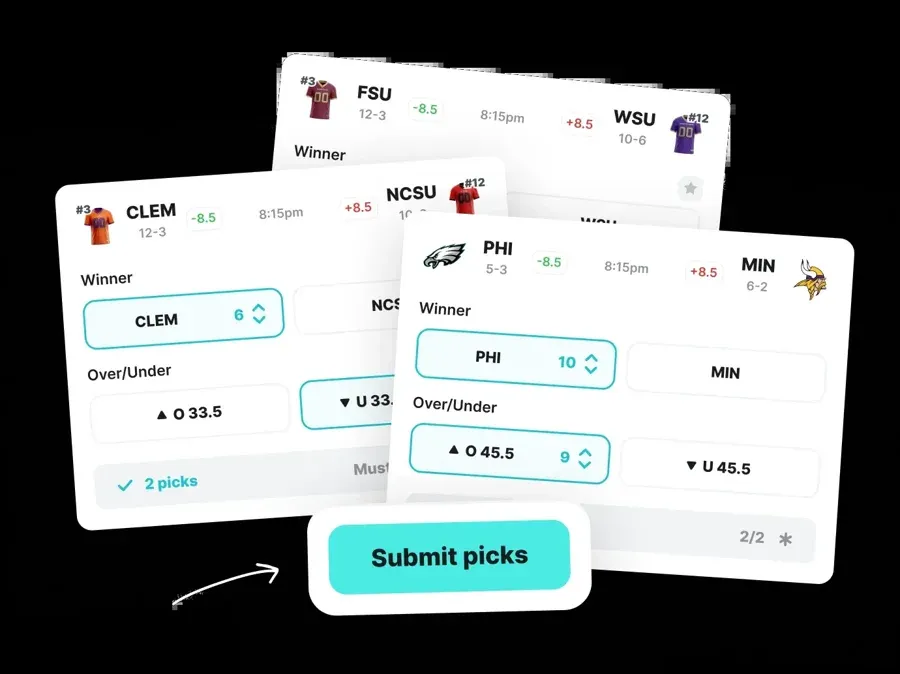
Monday, 11:40 p.m. The last game just went final, and two people in your pool both went 12-4.
One says split it. The other says they had more right on Sunday, so it's theirs. Someone digs up a text from August that may or may not count as the rules.
You're the commissioner. Everyone is looking at you.
This is avoidable. Here's how to choose a primary tiebreaker, set up the Monday total, add a backup, decide when to split and post it all before the first kickoff.
Why every NFL pick em pool needs a tiebreaker
Ties are a when, not an if
What you need
- Your scoring format — One point per pick, weighted games or confidence.
- The week's schedule — So you can name the tiebreaker game by matchup.
- One place for the rules — A pinned post, the contest page or the group chat description.
In an NFL weekly pick em, everyone picks the same slate and scores a point per correct pick. That means every score is a whole number, and everyone is chasing the same small range of them.
Put 20 people on a 16-game slate and several of them are going to land on the same number. Bye weeks make it tighter. In 2026, six teams are off in Week 11, which cuts that week to 13 games.
A tie isn't a rare edge case. It's a normal Monday.
A good tiebreaker has three traits. It's decided by something players entered before kickoff. It's settled by a game everyone can watch. And it never needs the commissioner to make a judgment call after the fact.
If your rule needs you to decide who "deserves" it, you don't have a rule yet.
Steps to set your tiebreakers
Five decisions, made once
Every NFL pick em pool needs the same five decisions. Make them before Week 1 and you won't have to make them again in a hurry.
Step 1
Choose a primary tiebreaker
One rule settles most ties
Your primary tiebreaker decides the large majority of ties, so make it the clearest one you have.
The common choices are a score prediction on a designated game, most correct on a specific day or game, or head-to-head results between the tied players. For weekly prizes, the score prediction usually wins out because it's a number, not a count, and numbers rarely land exactly level.
If you run your contest on Splash, you can set this up as you build a pick em contest, alongside scoring, spreads and drop weeks.
Step 2
Use a Monday night football tiebreaker on total points
One number, guessed by everyone
The classic Monday Night Football tiebreaker asks each player to predict the combined points scored by both teams in the Monday game. Closest guess wins the tie.
It works because the game kicks off after everything else, so the tiebreaker is still live while the rest of the week plays out.
Write down three details. Whether going over the real total disqualifies a guess. What counts as "the Monday game". And whether overtime points count.
That second one matters. In 2022 the NFL put two Monday games on the same night for the first time, and holiday weeks shuffle the usual days. Name the tiebreaker game by matchup each week, using the official NFL schedule.
Step 3
Add a backup tiebreaker
Then plan for the tie after the tie
Two players guess 44. Or one guesses 41, the other 47, and the final is 44. Your primary rule just tied too.
A backup handles it. Good options are most correct picks in the tiebreaker game itself, head-to-head results between the tied players, fewer missed or auto-filled picks, or most correct on Sunday.
Stack them in order and publish the order. Two backups are plenty for a weekly prize. A season-long race can justify three.
Step 4
Decide when to split the pot
Know when sharing beats sorting
Sometimes the cleanest answer is to split the pot evenly between the tied players.
Two cases make sense. First, when a tie survives every tiebreaker you listed, a split is the only fair finish. Second, some groups skip tiebreakers for small weekly prizes and split by design, then save the full tiebreaker stack for the season title.
Either way, write it down. "Ties split" is a perfectly good rule. "We'll figure it out" is not.
Step 5
Post the rules before kickoff
Rules first, kickoff second
Publish the full tiebreaker order before the first game of the season, and before the first game of any week where something changes.
First kickoff comes earlier than you think. The 2026 season opened on a Wednesday, September 9, and Thanksgiving week starts with a Wednesday game on November 25. If your pool locks every pick at the first kickoff of the week, Thursday is too late.
Pin the rules where every player sees them. A rule nobody saw is a rule somebody will fight.
Tip
Ask for the tiebreaker guess on the same form as the picks. If it's a separate step, someone will forget it, and a missing guess needs its own rule.
Weekly vs season-long tiebreakers
Two races need two rules
A weekly race and a season race tie for different reasons, so they need different tiebreakers.
Weekly NFL pick em games tie because the slate is short. A fresh score prediction every week fixes that, since it's a new number each Monday.
Season ties are rarer and stickier. By Week 18 your tied players have the same total correct, which is the score itself, so the tiebreaker has to measure something else. Season-long options include weeks won, total tiebreaker accuracy across the year, win percentage or fewer missed picks.
Scoring changes the tie rate as well. With one point per pick, scores bunch up. Weight some games and they spread out. On Splash, a commissioner can make primetime and divisional games worth more, or run confidence scoring, where each correct pick earns the rank a player gave it. A 12-person office pool on confidence points will see far fewer exact ties than the same group on straight wins.
Fewer ties doesn't mean none. Keep the tiebreaker order in place whatever scoring you choose.
Weekly and season-long tiebreakers side by side
| Weekly prize | Season title | |
|---|---|---|
| Why ties happen | Short slate, whole-number scores | Two players finish level after 18 weeks |
| Best primary | Monday total points guess | Weeks won or tiebreaker accuracy |
| Good backup | Head-to-head or most correct in the tiebreaker game | Win percentage or fewer missed picks |
| Split if still tied | Common and fine | Only after every backup |
| When to set it | Before Week 1 | Before Week 1 |
Drop weeks change the season math too. If players can drop their worst one or two weeks, decide whether your season tiebreaker uses the full season or the counted weeks only.
Most pick em NFL groups never write that down. Then it's December and it matters.
If you run your NFL pickem on paper, track the season tiebreaker stat every week as you go. Rebuilding it in December is a long night. Survivor contests have the same problem with a different scoreboard, which Splash covers in its guide to survivor tiebreakers & revivals.
Tiebreakers in an NFL pick em league on Splash
The tiebreaker order comes built in
Running an NFL pick em league on Splash takes most of this off your plate.
In the Splash Pick'Em game, ties are broken by default by the closest guess to the Monday-night total without going over, then head-to-head, then most correct on the week. You can change the order in settings.
Go further and you get a full cascade. Every week can include a score-prediction tiebreaker on a game you designate. The weekly, season and segment leaderboards each support their own reorderable order, built from points, wins, tiebreaker accuracy, Best Pick hits, fewer auto-picks used, win percentage and margin of victory.
So the weekly prize can run on the Monday total while the season title runs on weeks won. Two races, two rules, no spreadsheet.
The rest of the commissioner chores run themselves. Scoring posts live as games end and the leaderboard sorts itself. Reminders go out before the pick deadline. Auto-picks can fill missed games with the favorite or home team, and you can enter or edit a member's picks after lock when life happens. The full set lives in Splash commissioner tools.
Players compete against friends and other fans, not the house, and winners get paid automatically when contests end. Splash is available in most of the US and Canada, with eligibility that varies by location. Check where you can play before you send the invite.
Common mistakes to avoid
Small gaps start big arguments
Most pick em pool fights trace back to one of these.
- No tiebreaker at all. It works right up until the first tie.
- "The Monday game" with no matchup named. Name the game each week. Odd weeks happen.
- No rule for a tied guess. Two people will eventually pick the same number.
- One rule for both races. A Monday guess is great for a weekly prize and thin for a season title.
- Changing the rule after the tie. Changes apply to future weeks only, announced before kickoff.
- Leaving it to the commissioner. If you decide ties by judgment, you'll lose a friend per tie.
Set the order. Post it early. Let the Monday total do the arguing.
Frequently asked questions
Tiebreaker questions, answered
Predicting the total points scored in the Monday night game. Every player enters one number with their picks, and the closest guess wins the tie. It's the default on Splash Pick'em, which uses the closest guess without going over, then head-to-head, then most correct on the week.
Your backup tiebreaker decides it. Common backups are head-to-head results, most correct picks in the tiebreaker game, fewer missed picks or most correct on Sunday. If players are still level after every backup you listed, split the prize evenly. The key is publishing that full order before the season starts.
You can, but announce it first and apply it only from the next week forward. On Splash, most Pick'em settings can be edited after the season starts, and changes re-grade automatically and notify affected entrants. Even so, a change made right after a tie will look like it was made to pick the winner.
Yes, in most pools. Players pick a winner in the Monday game like any other and also guess its total. That keeps the slate simple and gives you a natural backup, since most correct in the tiebreaker game can settle a tied guess.
Neither is better, but they reward different guesses. Without going over pushes players to guess low, much like a price-guessing game show. Plain closest treats both directions the same. Pick one, write it in the rules and keep it for the whole season so nobody games the change.
